Skip to main content
Macroeconomics
My Course
Learn
Exam Prep
AI Tutor
Study Guides
Flashcards
Explore
Try the app
My Course
Learn
Exam Prep
AI Tutor
Study Guides
Flashcards
Explore
Try the app
Back
Balance of Trade; Trade Deficit and Trade Surplus definitions
You can tap to flip the card.
Balance of Trade
You can tap to flip the card.
👆
Balance of Trade
Difference between value of goods and services sold abroad and those bought from other countries; reflects net exports.
Track progress
Control buttons has been changed to "navigation" mode.
1/14
Related flashcards
Related practice
Recommended videos
Balance of Trade; Trade Deficit and Trade Surplus quiz
Balance of Trade; Trade Deficit and Trade Surplus
15 Terms
Balance of Trade; Trade Deficit and Trade Surplus
21. Open-Economy Macroeconomics
10 problems
Topic
22. Balance of Payments
5 topics
15 problems
Chapter
Guided course
06:55
Trade Deficit and Trade Surplus
1
views
Terms in this set (14)
Hide definitions
Balance of Trade
Difference between value of goods and services sold abroad and those bought from other countries; reflects net exports.
Trade Surplus
Situation where goods and services sold abroad exceed those purchased from other countries, indicating net positive exports.
Trade Deficit
Condition where goods and services bought from other countries surpass those sold abroad, resulting in negative net exports.
Net Exports
Total value of goods and services sold abroad minus those bought from other countries; can be positive or negative.
Open Economy
System where a country exchanges goods and services with other nations, allowing both imports and exports.
Closed Economy
System where a country does not engage in international exchange of goods and services; no imports or exports.
Exports
Goods and services produced domestically and sold to buyers in other countries, generating income from abroad.
Imports
Goods and services produced abroad and purchased by domestic consumers, reflecting foreign production in local markets.
Comparative Advantage
Ability to produce a good or service at a lower opportunity cost than others, driving international trade patterns.
Savings
Portion of current output not used for immediate consumption, potentially available for future investment or spending.
Investment
Allocation of current resources to activities or assets that increase future productive capacity or output.
Economic Investment
Spending on assets like factories or technology aimed at boosting future production, distinct from financial investments.
Financial Investment
Acquisition of assets such as stocks, bonds, or mutual funds, typically for earning returns rather than increasing output.
Balanced Trade
State where the value of goods and services sold abroad equals those bought from other countries; net exports are zero.
 BackBack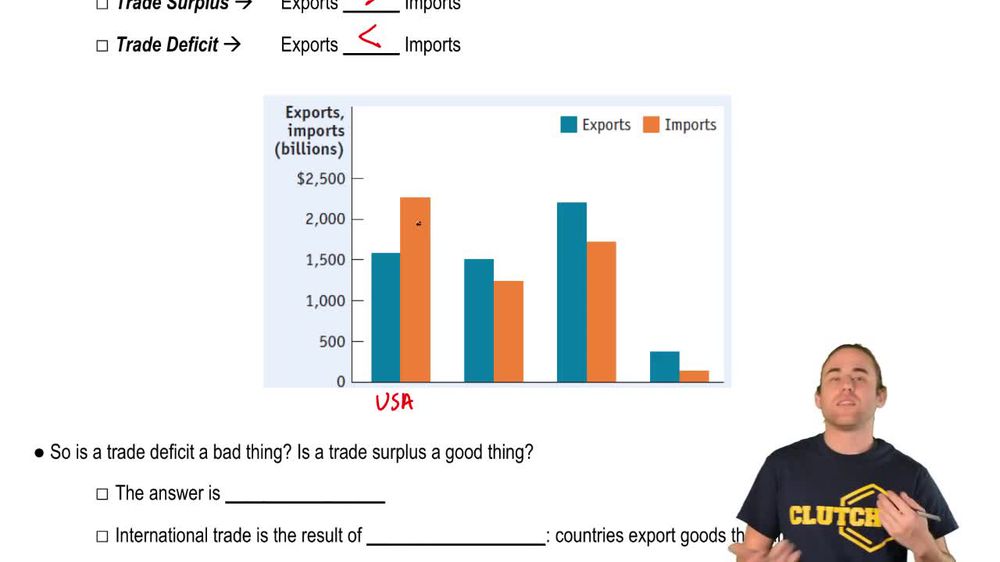
 06:55
06:55