What distinguishes the short run from the long run in terms of costs?
In the short run, some costs are fixed and cannot be changed, while in the long run, all costs become variable and firms can adjust their production decisions.
What does the short run average total cost (SRATC) curve typically look like?
The SRATC curve falls, reaches a minimum, and then rises as output increases.
Why are firms 'stuck' with certain decisions in the short run?
Firms are stuck with decisions like factory size or leases because these fixed costs cannot be changed quickly.
How does the long run average total cost (LRATC) curve relate to short run curves?
The LRATC curve is formed by choosing the lowest possible average total cost from all available short run curves for each output level.
What happens to average total cost in the first section of the LRATC curve as quantity increases?
Average total cost decreases as quantity increases, indicating economies of scale.
What is the main cause of economies of scale?
Economies of scale are mainly caused by specialization, bulk purchasing, and the use of large machinery.
What is the second section of the LRATC curve called, where costs remain constant?
This section is called constant returns to scale, where average total cost stays the same as output increases.
What is the minimum efficient scale?
Minimum efficient scale is the smallest quantity of output at which a firm achieves the lowest average total cost and exhausts economies of scale.
What happens to average total cost in the third section of the LRATC curve?
Average total cost increases as quantity increases, indicating diseconomies of scale.
What is the main cause of diseconomies of scale?
Diseconomies of scale are mainly caused by coordination and management problems in very large firms.
How did Henry Ford's experience illustrate diseconomies of scale?
Ford's huge factory led to rising costs due to coordination issues and inefficiency, showing that bigger is not always better.
Why can firms choose their factory size in the long run but not in the short run?
In the long run, all costs are variable, allowing firms to adjust factory size, while in the short run, fixed costs prevent such changes.
How does specialization contribute to economies of scale?
Specialization allows workers to become more efficient, reducing average total cost as output increases.
What is the relationship between output and average total cost during constant returns to scale?
During constant returns to scale, increasing output does not change the average total cost.
What is the significance of the minimum efficient scale for a firm?
It marks the point where a firm has fully benefited from economies of scale and further increases in output do not lower average total cost.
 Back
Back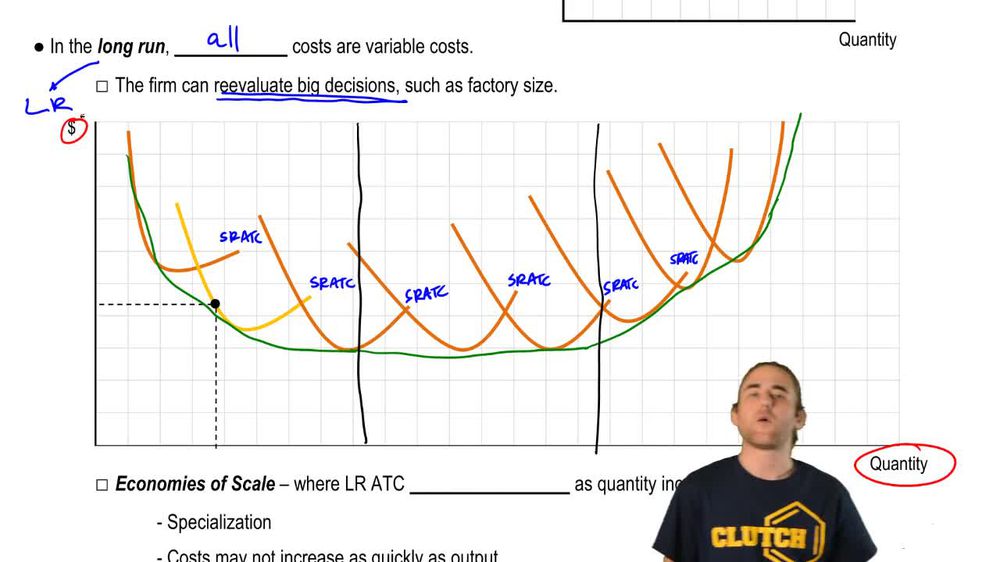
 13:13
13:13