Skip to main content
Macroeconomics
My Course
Learn
Exam Prep
AI Tutor
Study Guides
Flashcards
Explore
Try the app
My Course
Learn
Exam Prep
AI Tutor
Study Guides
Flashcards
Explore
Try the app
Back
Average Propensity to Consume and Save quiz
You can tap to flip the card.
What is disposable income?
You can tap to flip the card.
👆
What is disposable income?
Disposable income is the amount left after paying taxes, which can be used for consumption or savings.
Track progress
Control buttons has been changed to "navigation" mode.
1/15
Related flashcards
Related practice
Recommended videos
Average Propensity to Consume and Save definitions
Average Propensity to Consume and Save
13 Terms
Average Propensity to Consume and Save
14. Income and Consumption
10 problems
Topic
Multiplier Effect of Investment Spending
14. Income and Consumption
10 problems
Topic
15. Income and Consumption
5 topics
15 problems
Chapter
Guided course
01:50
Average Propensity to Consume and Save
5
views
Terms in this set (15)
Hide definitions
What is disposable income?
Disposable income is the amount left after paying taxes, which can be used for consumption or savings.
How is Average Propensity to Consume (APC) calculated?
APC is calculated as total consumption divided by total disposable income.
How is Average Propensity to Save (APS) calculated?
APS is calculated as total savings divided by total disposable income.
What does the term 'average' refer to in APC and APS?
The term 'average' refers to the total amounts of consumption or savings relative to total disposable income.
What is the formula for APC?
APC = Total Consumption / Total Disposable Income.
What is the formula for APS?
APS = Total Savings / Total Disposable Income.
What is Marginal Propensity to Consume (MPC)?
MPC measures how much consumption changes with an additional dollar of income.
What is Marginal Propensity to Save (MPS)?
MPS measures how much savings change with an additional dollar of income.
How do APC and APS differ from MPC and MPS?
APC and APS focus on total amounts, while MPC and MPS focus on changes with an extra dollar of income.
What does 'marginal' mean in economics?
'Marginal' refers to the change resulting from one more unit, such as an extra dollar of income.
What are the two main uses of disposable income?
Disposable income is used for either consumption or savings.
Why is it important to understand APC and APS?
Understanding APC and APS helps analyze rates of consumption and savings in the economy.
What does MPC tell us about consumer behavior?
MPC tells us how much more people consume when their income increases by one dollar.
What does MPS tell us about saving behavior?
MPS tells us how much more people save when their income increases by one dollar.
What is the relationship between consumption, savings, and disposable income?
Consumption and savings together make up the total disposable income after taxes.
 BackBack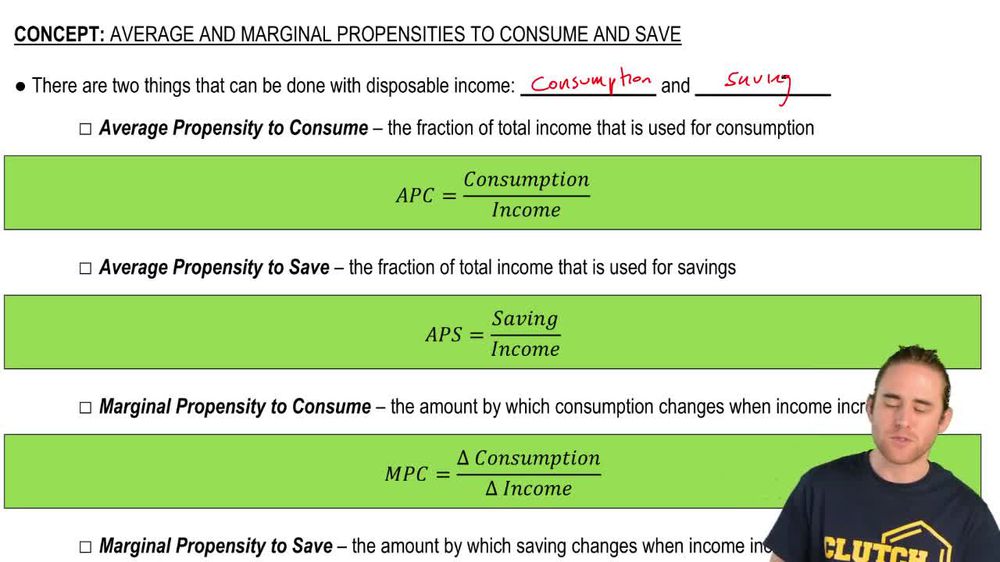
 01:50
01:50