Skip to main content
Macroeconomics
My Course
Learn
Exam Prep
AI Tutor
Study Guides
Flashcards
Explore
Try the app
My Course
Learn
Exam Prep
AI Tutor
Study Guides
Flashcards
Explore
Try the app
Back
Asymmetric Information: Adverse Selection and Moral Hazard quiz
You can tap to flip the card.
What is information asymmetry in economic transactions?
You can tap to flip the card.
👆
What is information asymmetry in economic transactions?
Information asymmetry occurs when one party in a transaction has more or better information than the other party.
Track progress
Control buttons has been changed to "navigation" mode.
1/15
Related flashcards
Recommended videos
Asymmetric Information: Adverse Selection and Moral Hazard definitions
Asymmetric Information: Adverse Selection and Moral Hazard
13 Terms
Guided course
04:03
Moral Hazard
Guided course
04:42
Adverse Selection
Guided course
02:19
Asymmetric Information
Terms in this set (15)
Hide definitions
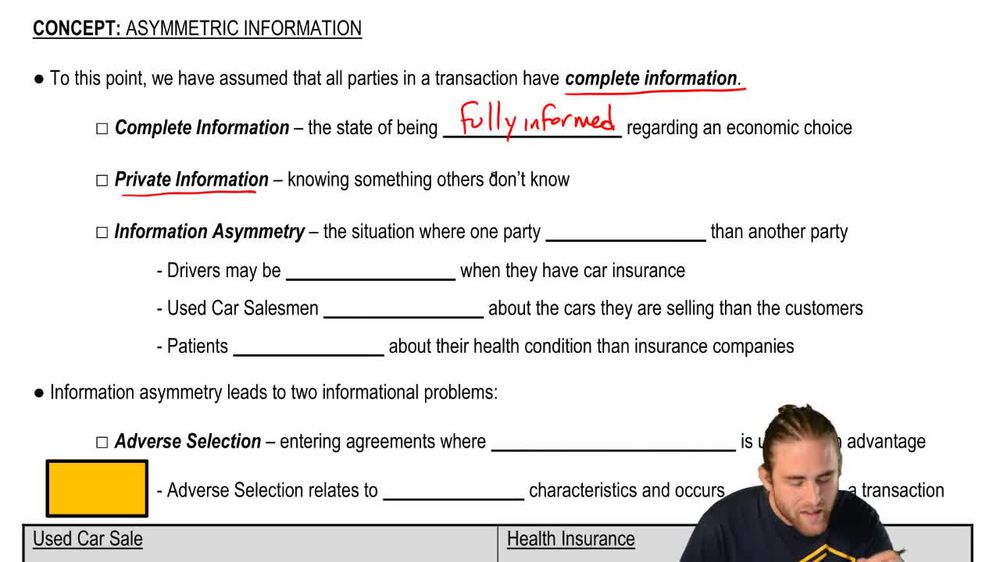
What is information asymmetry in economic transactions?
Information asymmetry occurs when one party in a transaction has more or better information than the other party.
What is private information?
Private information is knowledge that one party has but the other party does not in a transaction.
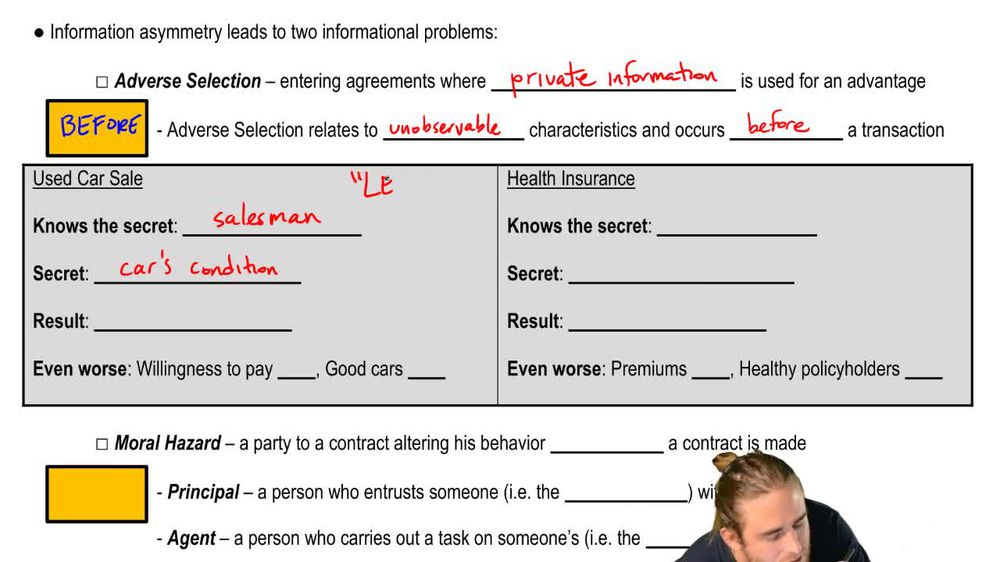
What is adverse selection and when does it occur?
Adverse selection is when one party uses private information to their advantage before a transaction, often involving unobservable characteristics.
What is the key difference in timing between adverse selection and moral hazard?
Adverse selection occurs before a transaction, while moral hazard occurs after a contract is made.
How does adverse selection affect the used car market?
Adverse selection leads buyers to fear getting a 'lemon,' reducing their willingness to pay and causing fewer good cars to be sold.
Why does adverse selection make health insurance more expensive for healthy people?
Because riskier individuals are more likely to buy insurance, insurers raise premiums, which may drive healthy people out of the market.
What is the 'lemon problem' in the context of used cars?
The 'lemon problem' refers to buyers' inability to distinguish good cars from bad ones, leading to market inefficiency.
What is moral hazard?
Moral hazard is when a party changes their behavior after a contract is made, often taking more risks because they are protected.
How does moral hazard relate to car insurance?
After getting car insurance, drivers may become less cautious because they know they are financially protected.
Who are the principal and agent in a principal-agent relationship?
The principal entrusts the agent with a task, often paying them to act on their behalf.
How can moral hazard appear in an employer-employee relationship?
An employee may slack off or reduce effort after being hired, especially if not closely monitored.
Why is monitoring important in preventing moral hazard?
Monitoring helps ensure that agents (like employees) do not change their behavior in undesirable ways after a contract.
How does adverse selection worsen over time in insurance markets?
As premiums rise due to high claims, healthy people leave, making the insured pool riskier and further increasing premiums.
What role does unobservable information play in adverse selection?
Unobservable information, like hidden health problems, allows one party to benefit at the expense of the other before a transaction.
Why is understanding asymmetric information important in macroeconomics?
It helps analyze how risk, incentives, and market efficiency are affected in aggregate demand and economic transactions.
 BackBack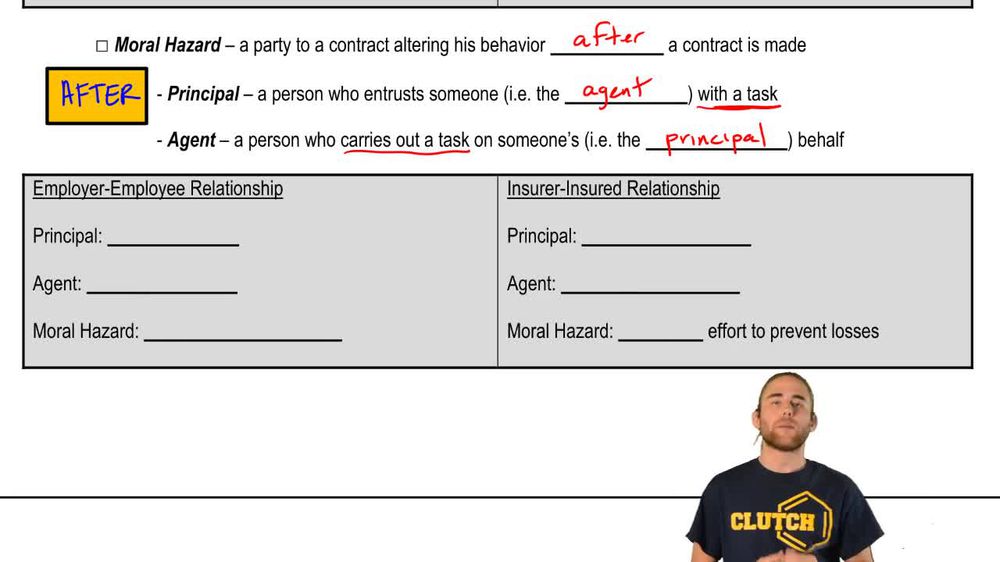
 04:03
04:03