Skip to main content
Macroeconomics
My Course
Learn
Exam Prep
AI Tutor
Study Guides
Flashcards
Explore
Try the app
My Course
Learn
Exam Prep
AI Tutor
Study Guides
Flashcards
Explore
Try the app
Back
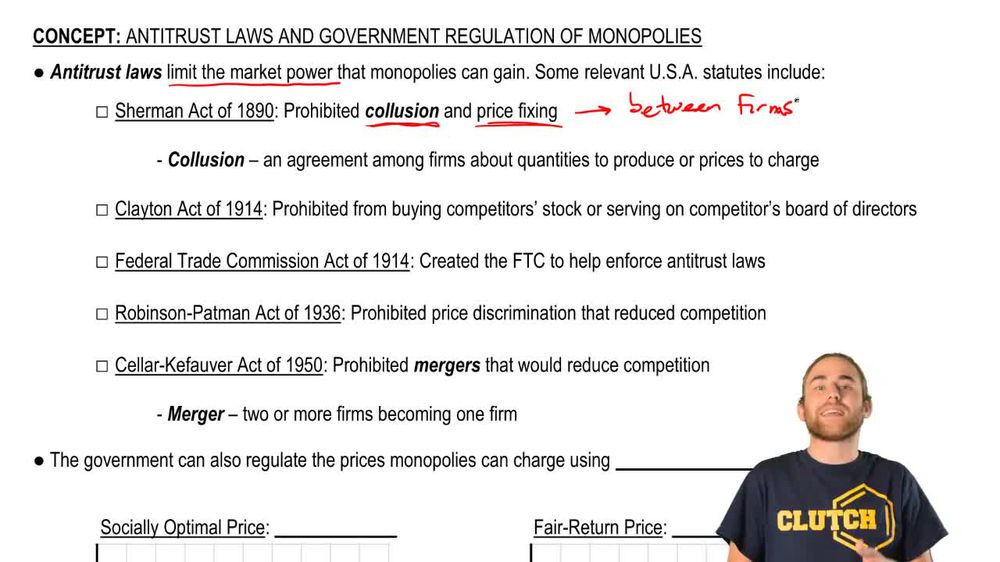
Antitrust Laws and Government Regulation of Monopolies definitions
You can tap to flip the card.
Antitrust Laws
You can tap to flip the card.
👆
Antitrust Laws
Legal measures designed to restrict market dominance and prevent practices that reduce competition among firms.
Track progress
Control buttons has been changed to "navigation" mode.
1/15
Related flashcards
Recommended videos
Antitrust Laws and Government Regulation of Monopolies quiz
Antitrust Laws and Government Regulation of Monopolies
15 Terms
Guided course
07:21
Monopoly:Socially Optimal Price and Fair-Return Price
1
views
Guided course
03:58
Antitrust Laws
1
views
Terms in this set (15)
Hide definitions
Antitrust Laws
Legal measures designed to restrict market dominance and prevent practices that reduce competition among firms.
Sherman Act
A foundational statute that prohibits agreements among firms to fix prices or collude, aiming to preserve market competition.
Clayton Act
Legislation that bans firms from acquiring competitors' stock or sharing board members to prevent anti-competitive consolidation.
Federal Trade Commission
A government agency responsible for enforcing competition laws and overseeing anti-competitive business practices.
Collusion
A secretive arrangement between firms to set prices or output, undermining competition and harming consumers.
Price Fixing
An agreement among competitors to set prices at a certain level, eliminating independent pricing and harming market fairness.
Price Discrimination
Charging different prices to various customers, which is only restricted when it significantly reduces competition.
Mergers
The combination of two firms, which may be blocked if it substantially decreases competition in the market.
Price Ceiling
A regulatory cap on the maximum price a monopoly can charge, set to protect consumers and improve market outcomes.
Socially Optimal Price
A regulated price where consumer benefit equals production cost, maximizing efficiency but possibly causing firm losses.
Fair Return Price
A regulated price set at the firm's average total cost, ensuring no profit but allowing cost coverage and continued operation.
Deadweight Loss
The loss of total surplus due to unmade trades, often resulting from monopolistic pricing or imperfect regulation.
Allocative Efficiency
A market state where resources are distributed so that consumer benefit matches production cost for the last unit.
Productive Efficiency
A condition where goods are produced at the lowest possible cost, typically achieved when price equals average total cost.
Market Power
The ability of a firm to influence prices and output levels, often leading to reduced competition and higher profits.
 BackBack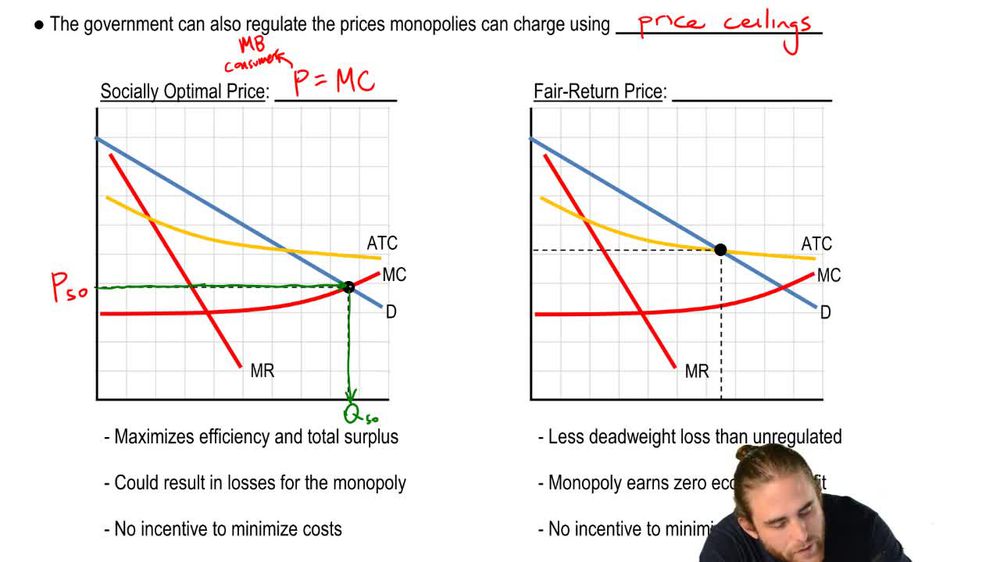
 07:21
07:21