Skip to main content
Introduction to Chemistry
My Course
Learn
Exam Prep
AI Tutor
Study Guides
Flashcards
Explore
Try the app
My Course
Learn
Exam Prep
AI Tutor
Study Guides
Flashcards
Explore
Try the app
Back
Wavelength and Frequency (Simplified) quiz
You can tap to flip the card.
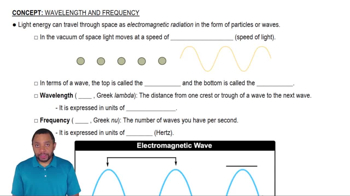
What is the speed of light in a vacuum?
You can tap to flip the card.
👆
What is the speed of light in a vacuum?
The speed of light in a vacuum is 3.00 x 10^8 meters per second.
Track progress
Control buttons has been changed to "navigation" mode.
1/15
Related flashcards
Related practice
Recommended videos
Wavelength and Frequency (Simplified) definitions
Wavelength and Frequency (Simplified)
14 Terms
Wavelength and Frequency (Simplified)
9. Electrons in Atoms and the Periodic Table
5 problems
Topic
Electromagnetic Spectrum (Simplified)
9. Electrons in Atoms and the Periodic Table
5 problems
Topic
9. Electrons in Atoms and the Periodic Table - Part 3 of 4
12 topics
36 problems
Chapter
Guided course
01:12
Wavelength and Frequency (Simplified) Concept 2
4
views
Guided course
3:05
Wavelength and Frequency (Simplified) Concept 1
11
views
Guided course
00:59
Wavelength and Frequency (Simplified) Example 1
40
views
2
rank
Terms in this set (15)
Hide definitions
What is the speed of light in a vacuum?
The speed of light in a vacuum is 3.00 x 10^8 meters per second.
What is the Greek symbol for wavelength?
The Greek symbol for wavelength is lambda (λ).
How is wavelength defined in terms of a wave?
Wavelength is the distance from one crest to the next crest or from one trough to the next trough.
What units are used to measure wavelength?
Wavelength is measured in meters (m).
What is the Greek symbol for frequency?
The Greek symbol for frequency is mu (ν), which looks like a curvy v.
How is frequency defined for a wave?
Frequency is the number of waves that pass a point in one second.
What units are used to measure frequency?
Frequency is measured in hertz (Hz) or inverse seconds (s⁻¹).
What are the top and bottom parts of a wave called?
The top of a wave is called the crest, and the bottom is called the trough.
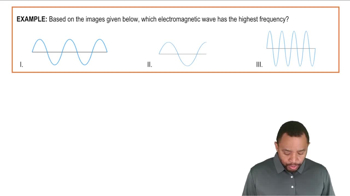
How does frequency relate to wavelength at a fixed speed?
Frequency is inversely proportional to wavelength; as one increases, the other decreases.
How does frequency relate to energy?
Frequency is directly proportional to energy; as frequency increases, energy also increases.
What happens to wavelength when frequency increases?
When frequency increases, wavelength decreases.
What happens to energy when frequency decreases?
When frequency decreases, energy also decreases.
How can light be described in terms of its nature?
Light can be described as both particles (photons) and waves.
If a wave has a low frequency, what can you say about its wavelength?
If a wave has a low frequency, its wavelength is long (large).
If a wave has a high frequency, what can you say about its energy?
If a wave has a high frequency, its energy is also high.
 BackBack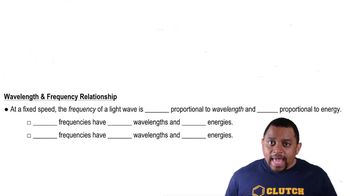
 01:12
01:12