Skip to main content
Introduction to Chemistry
My Course
Learn
Exam Prep
AI Tutor
Study Guides
Flashcards
Explore
Try the app
My Course
Learn
Exam Prep
AI Tutor
Study Guides
Flashcards
Explore
Try the app
Back
Valence Electrons of Elements (Simplified) definitions
You can tap to flip the card.
Valence Electrons
You can tap to flip the card.
👆
Valence Electrons
Outer shell particles responsible for chemical bonding, with a quantity matching the group number for main group elements.
Track progress
Control buttons has been changed to "navigation" mode.
1/12
Related flashcards
Related practice
Recommended videos
Valence Electrons of Elements (Simplified) quiz #1
Valence Electrons of Elements (Simplified)
40 Terms
Valence Electrons of Elements (Simplified) quiz #2
Valence Electrons of Elements (Simplified)
20 Terms
Valence Electrons of Elements (Simplified)
9. Electrons in Atoms and the Periodic Table
5 problems
Topic
Periodic Trend: Metallic Character
9. Electrons in Atoms and the Periodic Table
5 problems
Topic
9. Electrons in Atoms and the Periodic Table - Part 3 of 4
12 topics
36 problems
Chapter
Guided course
01:14
Valence Electrons of Elements (Simplified) Example 1
4
views
Guided course
01:55
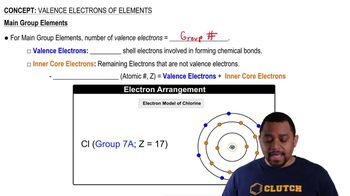
Valence Electrons of Elements (Simplified) Concept 1
3
views
Terms in this set (12)
Hide definitions
Valence Electrons
Outer shell particles responsible for chemical bonding, with a quantity matching the group number for main group elements.
Main Group Elements
Elements in groups 1A to 8A whose outermost particles determine their chemical properties and reactivity.
Group Number
Numerical label on the periodic table columns indicating the count of outermost shell particles for main group elements.
Chemical Bonds
Connections formed between atoms due to interactions involving outermost shell particles.
Inner Core Electrons
Particles located in shells beneath the outermost shell, not involved in bonding or chemical reactions.
Atomic Number
Unique identifier for an element, equal to the total count of positively charged particles and neutral atom particles.
Neutral Element
Species with equal numbers of positively charged and negatively charged particles, resulting in no overall charge.
Electron Shell
Energy level surrounding the nucleus where negatively charged particles are arranged in layers.
Outer Shell
Furthest energy level from the nucleus containing the particles responsible for chemical interactions.
Protons
Positively charged particles in the nucleus, whose count defines the identity of an element.
Chlorine
Element with 17 negatively charged particles, 7 of which occupy the third energy level, influencing its reactivity.
Shell Number
Numerical designation (n=1, n=2, n=3, etc.) indicating the distance of an energy level from the nucleus.
 BackBack
 01:14
01:14