Skip to main content
Introduction to Chemistry
My Course
Learn
Exam Prep
AI Tutor
Study Guides
Flashcards
Explore
Try the app
My Course
Learn
Exam Prep
AI Tutor
Study Guides
Flashcards
Explore
Try the app
Back
Types of Chemical Reactions definitions
You can tap to flip the card.
Chemical Reaction
You can tap to flip the card.
👆
Chemical Reaction
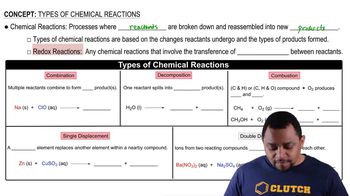
A process where reactants are broken down and reassembled into new products with different properties.
Track progress
Control buttons has been changed to "navigation" mode.
1/15
Related flashcards
Related practice
Recommended videos
Types of Chemical Reactions quiz
Types of Chemical Reactions
15 Terms
Types of Chemical Reactions
7. Chemical Reactions
5 problems
Topic
Complete Ionic Equations
7. Chemical Reactions
5 problems
Topic
7. Chemical Reactions
8 topics
24 problems
Chapter
Guided course
01:40
Types of Chemical Reactions Example 1
3
views
Guided course
04:07
Types of Chemical Reactions Concept 1
3
views
1
rank
Terms in this set (15)
Hide definitions
Chemical Reaction
A process where reactants are broken down and reassembled into new products with different properties.
Reactant
A starting substance that undergoes change during a chemical process to form new materials.
Product
A new substance formed as a result of a chemical process involving rearrangement of atoms.
Redox Reaction
A process involving the transfer of electrons between substances, altering their oxidation states.
Combination Reaction
A process where two or more substances merge to yield a single new compound.
Decomposition Reaction
A process where a single substance splits into two or more simpler products.
Combustion Reaction
A reaction where a carbon-based compound reacts with oxygen to produce water and carbon dioxide.
Single Displacement Reaction
A process where one element replaces another within a compound, forming a new element and compound.
Double Displacement Reaction
A process where ions from two compounds exchange partners, forming two new compounds.
Ionic Compound
A substance formed from the electrostatic attraction between oppositely charged ions.
Electron Transfer
The movement of electrons from one atom or molecule to another, often driving chemical changes.
Hydrocarbon
A molecule composed only of carbon and hydrogen atoms, often involved in prioritizing combustion.
Oxidation State
A value representing the hypothetical charge an atom would have if all bonds were ionic.
Ion Exchange
The swapping of charged particles between compounds during certain chemical processes.
Equation Recognition
The skill of identifying the type of chemical process based on the reactants and products involved.
 BackBack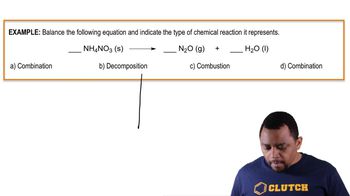
 01:40
01:40