Skip to main content
Introduction to Chemistry
My Course
Learn
Exam Prep
AI Tutor
Study Guides
Flashcards
Explore
Try the app
My Course
Learn
Exam Prep
AI Tutor
Study Guides
Flashcards
Explore
Try the app
Back
The Ideal Gas Law quiz
You can tap to flip the card.
What is the formula for the ideal gas law?
You can tap to flip the card.
👆
What is the formula for the ideal gas law?
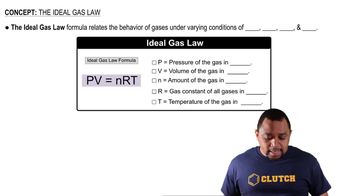
The formula is PV = nRT, where P is pressure, V is volume, n is moles, R is the gas constant, and T is temperature.
Track progress
Control buttons has been changed to "navigation" mode.
1/15
Related flashcards
Related practice
Recommended videos
The Ideal Gas Law definitions
The Ideal Gas Law
14 Terms
The Ideal Gas Law
11 Gases
5 problems
Topic
The Ideal Gas Law Derivations
11 Gases
5 problems
Topic
11 Gases
10 topics
30 problems
Chapter
Guided course
02:58
The Ideal Gas Law Example 1
49
views
3
rank
Guided course
01:15
The Ideal Gas Law
71
views
2
rank
Guided course
01:56
The Ideal Gas Law
32
views
2
rank
Terms in this set (15)
Hide definitions
What is the formula for the ideal gas law?
The formula is PV = nRT, where P is pressure, V is volume, n is moles, R is the gas constant, and T is temperature.
What units are used for pressure in the ideal gas law?
Pressure is measured in atmospheres (atm) when using the ideal gas law.
What units are used for volume in the ideal gas law?
Volume is measured in liters (L) in the ideal gas law.
What does 'n' represent in the ideal gas law equation?
'n' represents the amount of gas in moles.
What is the typical value of the gas constant R for the ideal gas law?
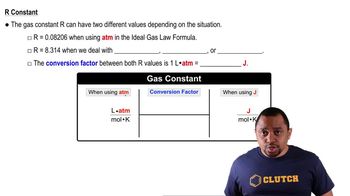
R is typically 0.08206 liters·atmospheres/(mole·Kelvin) for the ideal gas law.
What units are used for temperature in the ideal gas law?
Temperature is measured in Kelvins (K) in the ideal gas law.
When do you use the value 8.314 for the gas constant R?
Use 8.314 joules/(mole·Kelvin) for R when dealing with speed, velocity, or energy calculations.
What is the conversion factor between liters·atmospheres and joules?
1 liter·atmosphere equals 101.325 joules.
How do you convert R from 0.08206 to 8.314?
Multiply 0.08206 by 101.325 to cancel out liters·atmospheres and convert to joules, resulting in 8.314.
Why is it important to memorize the ideal gas law formula?
Professors expect you to know it, and it is used in many calculations throughout the chapter.
What happens to the units of R when converting for energy calculations?
The units change from liters·atmospheres/(mole·Kelvin) to joules/(mole·Kelvin).
What value of R should you use for calculations involving the ideal gas law?
Use R = 0.08206 liters·atmospheres/(mole·Kelvin) for ideal gas law calculations.
What value of R should you use for calculations involving energy?
Use R = 8.314 joules/(mole·Kelvin) for energy-related calculations.
What is the significance of the conversion factor 101.325 in gas law calculations?
It allows conversion between liters·atmospheres and joules, which is necessary for energy calculations.
What are the four variables related in the ideal gas law?
The four variables are pressure (P), volume (V), moles (n), and temperature (T).
 BackBack
 02:58
02:58