Skip to main content
Introduction to Chemistry
My Course
Learn
Exam Prep
AI Tutor
Study Guides
Flashcards
Explore
Try the app
My Course
Learn
Exam Prep
AI Tutor
Study Guides
Flashcards
Explore
Try the app
Back
Subatomic Particles (Simplified) definitions
You can tap to flip the card.
Atom
You can tap to flip the card.
👆
Atom
A structure composed of a nucleus surrounded by electrons, forming the basic unit of matter.
Track progress
Control buttons has been changed to "navigation" mode.
1/13
Related flashcards
Related practice
Recommended videos
Subatomic Particles (Simplified) quiz #1
Subatomic Particles (Simplified)
40 Terms
Subatomic Particles (Simplified) quiz #2
Subatomic Particles (Simplified)
40 Terms
Subatomic Particles (Simplified) quiz #3
Subatomic Particles (Simplified)
40 Terms
Subatomic Particles (Simplified)
4. Atoms and Elements
5 problems
Topic
Isotopes
4. Atoms and Elements
5 problems
Topic
4. Atoms and Elements - Part 1 of 2
12 topics
34 problems
Chapter
4. Atoms and Elements - Part 2 of 2
1 topic
3 problems
Chapter
Guided course
01:25
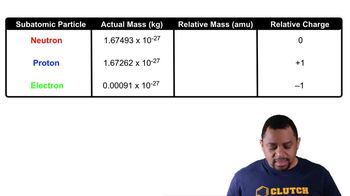
Subatomic Particles (Simplified) Concept 1
9
views
1
rank
Guided course
02:36
Subatomic Particles (Simplified) Concept 2
12
views
Guided course
03:31
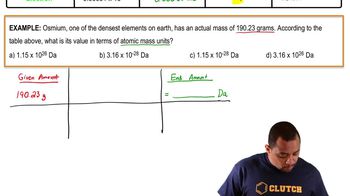
Subatomic Particles (Simplified) Example 1
97
views
3
rank
Terms in this set (13)
Hide definitions
Atom
A structure composed of a nucleus surrounded by electrons, forming the basic unit of matter.
Nucleus
A dense, tiny region at the center of an atom containing nearly all its mass from protons and neutrons.
Subatomic Particle
A component of atoms, including neutrons, protons, and electrons, each with distinct mass and charge.
Neutron
A neutral particle found in the nucleus, slightly heavier than a proton, contributing to atomic mass.
Proton
A positively charged particle in the nucleus, nearly equal in mass to a neutron, defining atomic identity.
Electron
A negatively charged, extremely light particle orbiting the nucleus, balancing atomic charge.
Atomic Mass Unit
A standard for measuring atomic and subatomic masses, equal to 1/12 the mass of a carbon atom.
Dalton
A unit of mass for atoms and molecules, numerically identical to the atomic mass unit.
Relative Mass
A comparison of a particle's mass to the atomic mass unit, allowing easy mass calculations.
Actual Mass
The measured mass of a particle in kilograms, used for precise scientific calculations.
Relative Charge
A comparison of a particle's electric charge to a standard, such as +1 for protons and -1 for electrons.
Conversion Factor
A numerical value, such as 1.66 x 10^-27 kg per AMU, used to switch between units of mass.
Density
A measure of how much mass is packed into a given volume, especially high in the atomic nucleus.
 BackBack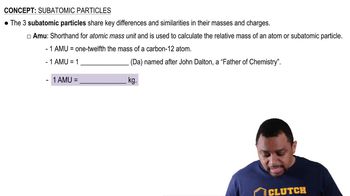
 01:25
01:25