Skip to main content
Introduction to Chemistry
My Course
Learn
Exam Prep
AI Tutor
Study Guides
Flashcards
Explore
Try the app
My Course
Learn
Exam Prep
AI Tutor
Study Guides
Flashcards
Explore
Try the app
Back
States of Matter definitions
You can tap to flip the card.
Solid
You can tap to flip the card.
👆
Solid
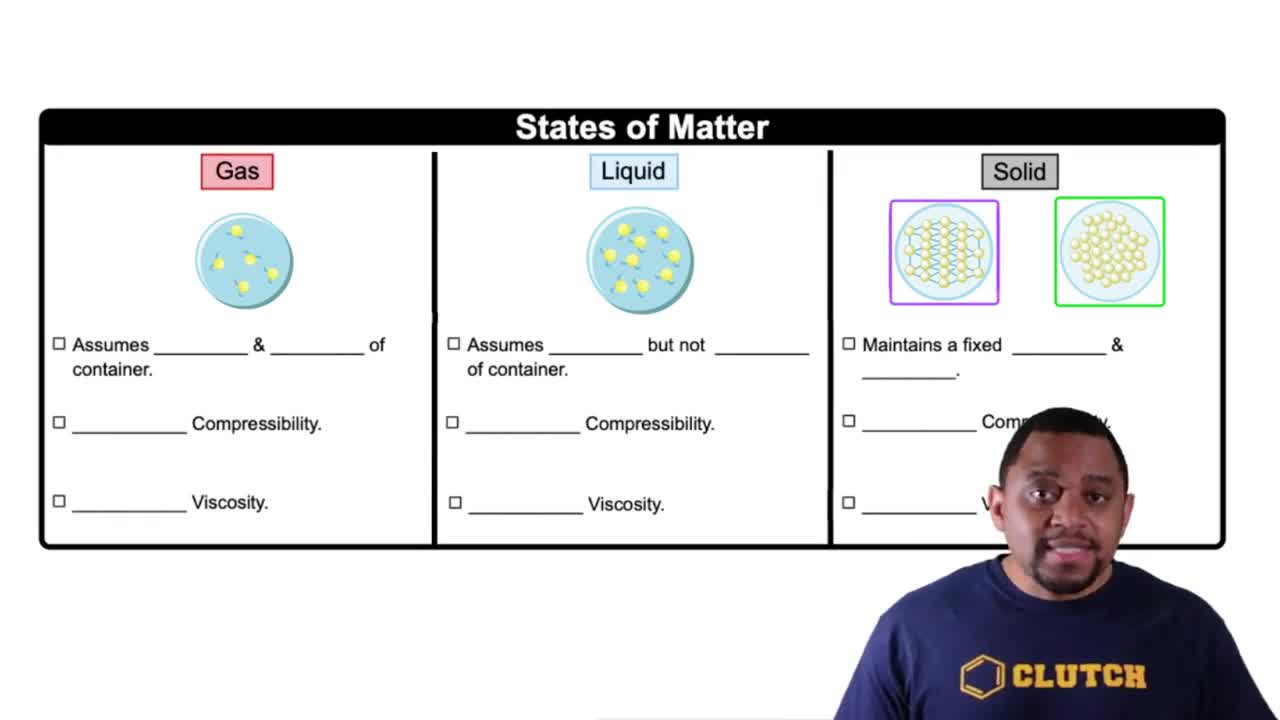
A form with fixed shape and volume, where particles are locked in place and resist movement unless force is applied.
Track progress
Control buttons has been changed to "navigation" mode.
1/13
Related flashcards
Related practice
Recommended videos
States of Matter quiz #1
States of Matter
10 Terms
States of Matter
3. Matter and Energy
5 problems
Topic
Physical & Chemical Changes
3. Matter and Energy
5 problems
Topic
3. Matter and Energy - Part 1 of 2
12 topics
34 problems
Chapter
3. Matter and Energy - Part 2 of 2
1 topic
3 problems
Chapter
Guided course
01:35
States of Matter Concept 1
25
views
2
rank
Guided course
01:01
States of Matter Example 1
14
views
Guided course
02:23
States of Matter Concept 2
14
views
Terms in this set (13)
Hide definitions
Solid
A form with fixed shape and volume, where particles are locked in place and resist movement unless force is applied.
Liquid
A form that adapts to the shape but not necessarily the volume of its container, with particles moving freely but still close together.
Gas
A form that takes both the shape and volume of its container, with particles spread far apart and moving rapidly.
Compressibility
The capacity of a substance to decrease in size when pressure is applied, highest in gases and lowest in solids.
Viscosity
The resistance a substance offers to flow or change in shape; higher values mean slower movement.
Physical Property
A characteristic such as appearance or state that can be observed without changing the substance's identity.
Container
An object that determines the possible shape and, for gases, the volume a substance can occupy.
Molecule
A group of atoms bonded together, whose arrangement and movement differ in solids, liquids, and gases.
Volume
The amount of three-dimensional space a substance occupies, which can be fixed or variable depending on the state.
Shape
The external form or outline of a substance, which may be maintained or adapted based on its state.
Pressure
A force applied to a substance that can alter its size, especially noticeable in gases due to their high compressibility.
Resistance to Flow
A measure of how difficult it is for a substance to move or change shape, closely related to viscosity.
Phase
A distinct form in which matter can exist, such as solid, liquid, or gas, each with unique properties.
 BackBack
 01:35
01:35