Skip to main content
Introduction to Chemistry
My Course
Learn
Exam Prep
AI Tutor
Study Guides
Flashcards
Explore
Try the app
My Course
Learn
Exam Prep
AI Tutor
Study Guides
Flashcards
Explore
Try the app
Back
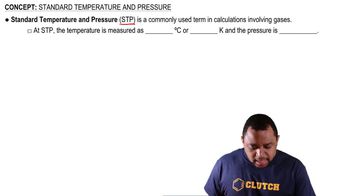
Standard Temperature and Pressure definitions
You can tap to flip the card.
Standard Temperature
You can tap to flip the card.
👆
Standard Temperature
A reference point set at 0 degrees Celsius or 273.15 Kelvin, used for consistency in gas calculations.
Track progress
Control buttons has been changed to "navigation" mode.
1/12
Related flashcards
Related practice
Recommended videos
Standard Temperature and Pressure quiz
Standard Temperature and Pressure
15 Terms
Standard Temperature and Pressure
11 Gases
5 problems
Topic
Dalton's Law: Partial Pressure (Simplified)
11 Gases
5 problems
Topic
11 Gases
10 topics
26 problems
Chapter
Guided course
02:20
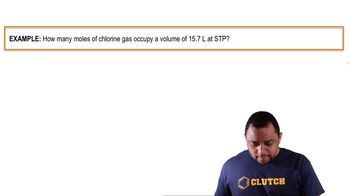
Standard Temperature and Pressure Example 1
16
views
Guided course
00:33
Standard Temperature and Pressure
14
views
Guided course
01:44
Standard Temperature and Pressure Example 2
13
views
Terms in this set (12)
Hide definitions
Standard Temperature
A reference point set at 0 degrees Celsius or 273.15 Kelvin, used for consistency in gas calculations.
Standard Pressure
A reference value of 1 atmosphere, commonly used in gas law calculations for uniformity.
STP
A set of conditions, specifically 273.15 Kelvin and 1 atmosphere, used as a baseline for gas measurements.
Ideal Gas
A theoretical substance whose particles occupy negligible space and experience no intermolecular forces.
Standard Molar Volume
The space occupied by 1 mole of an ideal gas at STP, numerically equal to 22.4 liters.
Mole
A counting unit representing Avogadro's number of particles, often used to relate mass and volume in chemistry.
Gas Constant
A proportionality factor, symbolized as R, used in equations relating pressure, volume, temperature, and moles.
Atmosphere
A unit of pressure defined as the average pressure at sea level, equivalent to 101.325 kPa.
Kelvin
An absolute temperature scale starting at absolute zero, commonly used in scientific temperature measurements.
Conversion Factor
A numerical ratio, such as 1 mole equals 22.4 liters at STP, used to switch between units in calculations.
Volume
The amount of three-dimensional space occupied by a substance, often measured in liters for gases.
Liter
A metric unit of volume commonly used to express the amount of space a gas occupies.
 BackBack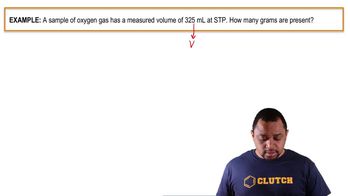
 02:20
02:20