Skip to main content
Introduction to Chemistry
My Course
Learn
Exam Prep
AI Tutor
Study Guides
Flashcards
Explore
Try the app
My Course
Learn
Exam Prep
AI Tutor
Study Guides
Flashcards
Explore
Try the app
Back
Spontaneous Redox Reactions definitions
You can tap to flip the card.
Redox Reaction
You can tap to flip the card.
👆
Redox Reaction
A process where one element is removed from a compound by another, involving electron transfer and changes in oxidation states.
Track progress
Control buttons has been changed to "navigation" mode.
1/14
Related flashcards
Related practice
Recommended videos
Spontaneous Redox Reactions quiz #1
Spontaneous Redox Reactions
10 Terms
Spontaneous Redox Reactions
16. Oxidation and Reduction
4 problems
Topic
Balancing Redox Reactions: Acidic Solutions
16. Oxidation and Reduction
5 problems
Topic
16. Oxidation and Reduction
6 topics
16 problems
Chapter
Guided course
01:52
Spontaneous Redox Reactions Example 1
4
views
Guided course
02:21
Spontaneous Redox Reactions Concept 1
4
views
Terms in this set (14)
Hide definitions
Redox Reaction
A process where one element is removed from a compound by another, involving electron transfer and changes in oxidation states.
Displacement
The removal of an element from its compound by another, resulting in the reduction of the displaced element.
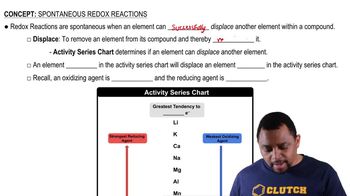
Activity Series
A ranked list of elements showing their ability to displace others, predicting which reactions will occur spontaneously.
Reducing Agent
A substance with a strong tendency to lose electrons, causing another to gain electrons and be reduced.
Oxidizing Agent
A substance with a strong tendency to gain electrons, causing another to lose electrons and be oxidized.
Oxidation
A process involving the loss of electrons, typically occurring in elements higher on the activity series.
Reduction
A process involving the gain of electrons, typically occurring in elements lower on the activity series.
Electron Transfer
The movement of electrons from one element to another, driving the changes in redox reactions.
Spontaneity
The natural tendency of a reaction to occur without external input, as predicted by the activity series.
Oxidation State
A value representing the number of electrons lost or gained by an atom in a compound during a reaction.
Tendency to Lose Electrons
A characteristic of elements higher in the activity series, indicating a strong likelihood of undergoing oxidation.
Tendency to Gain Electrons
A characteristic of elements lower in the activity series, indicating a strong likelihood of undergoing reduction.
Compound
A chemical substance formed from two or more elements, which can be broken apart during displacement.
Element
A pure substance that can participate in redox reactions, either displacing or being displaced in compounds.
 BackBack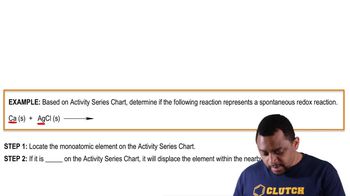
 01:52
01:52