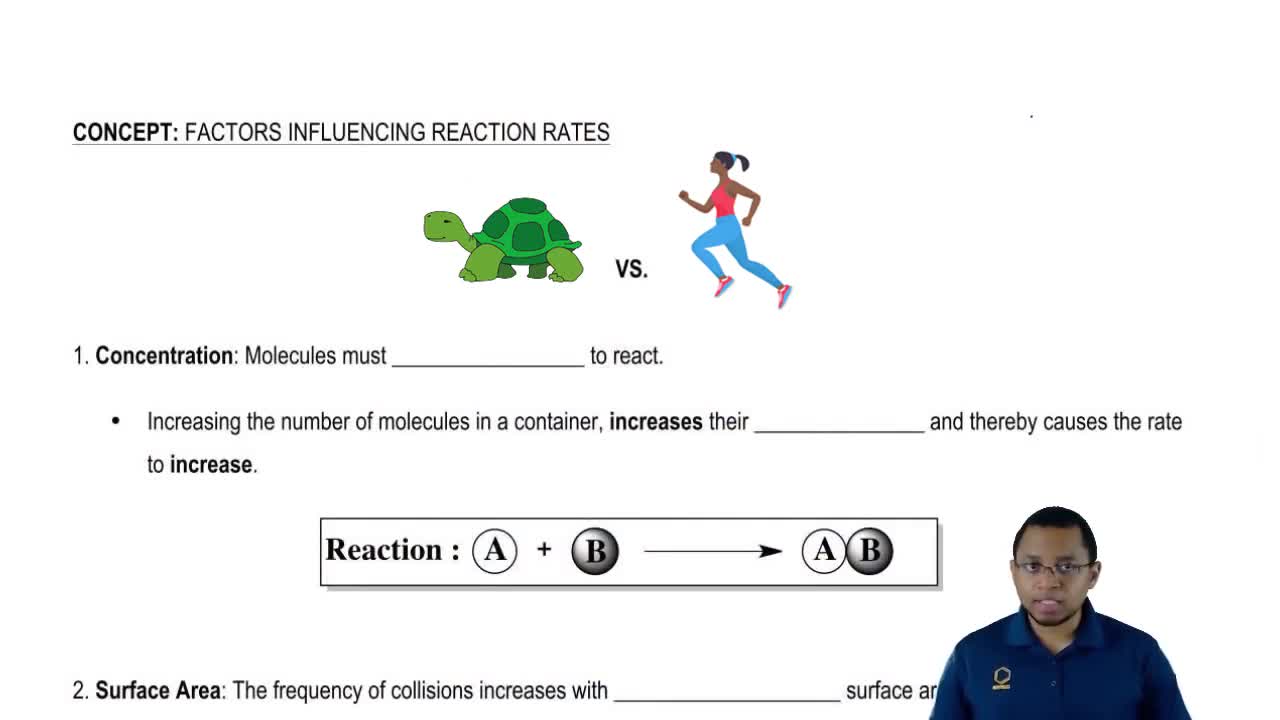
Chemical kinetics studies the rates of chemical reactions, focusing on how quickly reactants convert into products over time.
What is meant by the 'rate' of a chemical reaction?
The rate refers to the speed at which reactants or products change over a period of time during a chemical reaction.
What happens to reactants and products as a reaction goes to completion?
As a reaction goes to completion, almost all reactants are converted into products, leaving only products at the end.
How is equilibrium represented in a chemical equation?
Equilibrium is represented by two arrows, one going forward and one going backward, indicating both reactants and products coexist.
What is the first factor that influences the rate of a reaction?
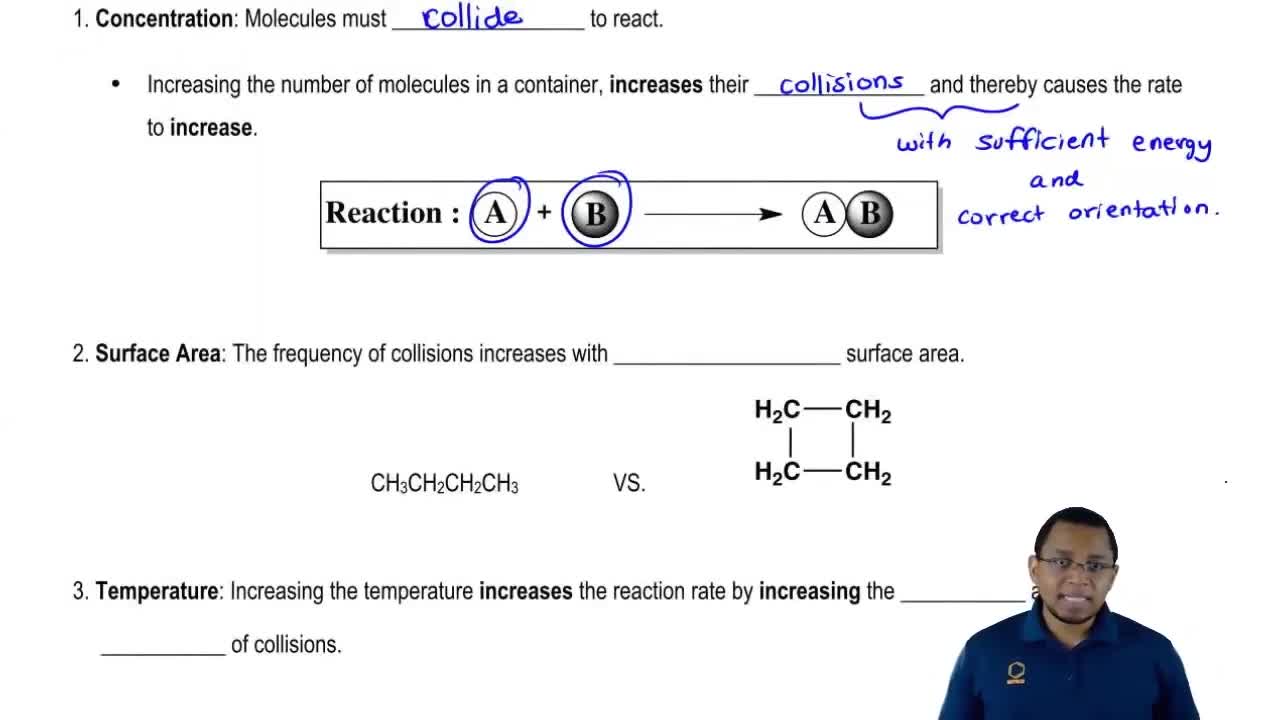
The first factor is concentration; increasing the concentration of reactants increases the likelihood of molecular collisions.
Why do molecules need to collide with sufficient energy and correct orientation?
Molecules must collide with enough energy and in the correct orientation to successfully form products; otherwise, they just bounce off each other.
How does surface area affect the rate of a reaction?
Greater surface area increases the frequency of collisions, leading to a faster reaction rate.
Why are linear structures more reactive than cyclic or branched structures?
Linear structures have more surface area exposed, making them more reactive and increasing the reaction rate compared to cyclic or branched structures.
What effect does temperature have on reaction rate?
Increasing temperature raises the energy and frequency of molecular collisions, thereby accelerating the reaction rate.
How do gas molecules behave when temperature is increased?
Gas molecules absorb thermal energy, convert it to kinetic energy, and move faster, increasing the chance of effective collisions.
What is a catalyst and how does it affect reaction rate?
A catalyst speeds up a reaction by lowering the activation energy required, making it easier for reactants to become products.
What is the transition state in a reaction's energy diagram?
The transition state is a hybrid between reactants and products, representing the highest energy point that must be overcome for the reaction to proceed.
How does a catalyst change the reaction pathway?
A catalyst lowers the energy of the transition state, reducing the activation energy and allowing the reaction to proceed faster.
What are the four main factors that can speed up a chemical reaction?
The four factors are increasing concentration, increasing surface area, increasing temperature, and adding a catalyst.
What must happen for a reaction to occur between molecules?
Molecules must collide with sufficient energy and correct orientation for a reaction to occur and products to form.
 Back
Back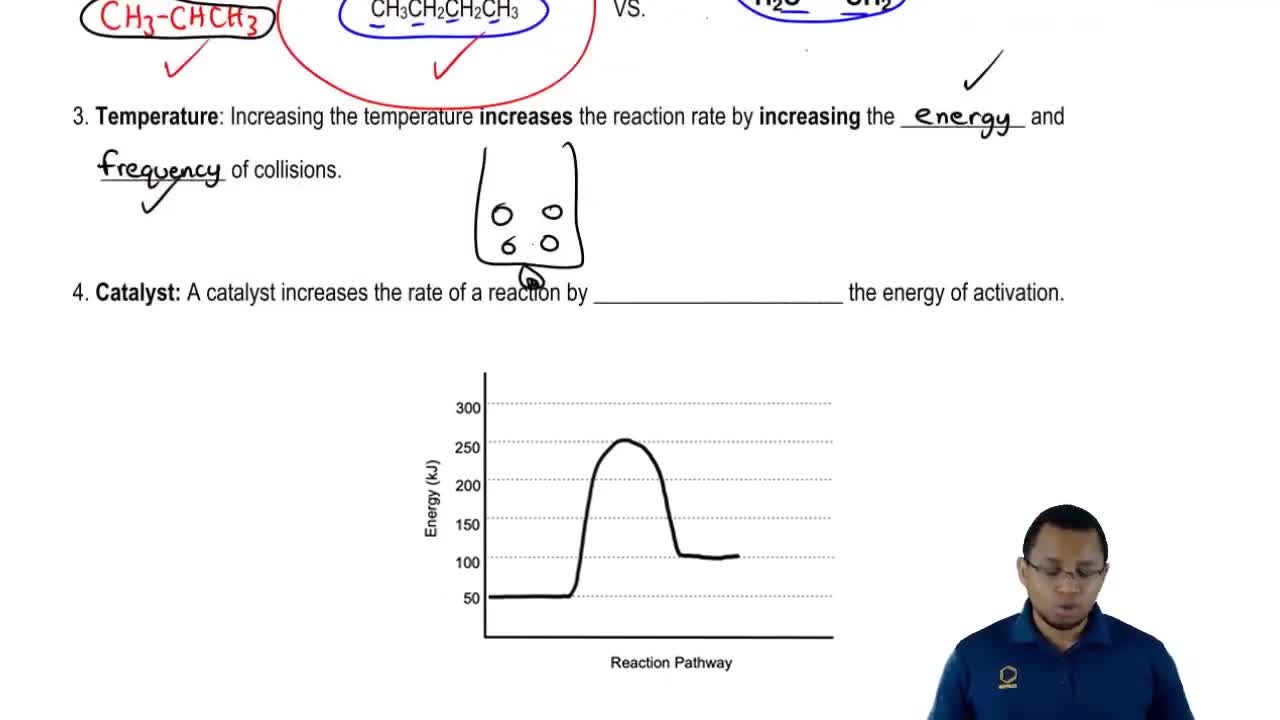
 02:16
02:16