Skip to main content
Introduction to Chemistry
My Course
Learn
Exam Prep
AI Tutor
Study Guides
Flashcards
Explore
Try the app
My Course
Learn
Exam Prep
AI Tutor
Study Guides
Flashcards
Explore
Try the app
Back
Periodic Trend: Ionization Energy (Simplified) definitions
You can tap to flip the card.
Ionization Energy
You can tap to flip the card.
👆
Ionization Energy
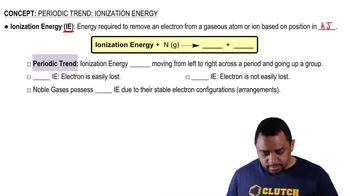
Energy input needed to detach an electron from a gaseous atom or ion, typically measured in kilojoules.
Track progress
Control buttons has been changed to "navigation" mode.
1/13
Related flashcards
Related practice
Recommended videos
Periodic Trend: Ionization Energy (Simplified) quiz #1
Periodic Trend: Ionization Energy (Simplified)
10 Terms
Periodic Trend: Ionization Energy (Simplified)
9. Electrons in Atoms and the Periodic Table
5 problems
Topic
Periodic Trend: Electron Affinity (Simplified)
9. Electrons in Atoms and the Periodic Table
5 problems
Topic
9. Electrons in Atoms and the Periodic Table - Part 3 of 4
12 topics
36 problems
Chapter
Guided course
00:40
Periodic Trend: Ionization Energy (Simplified) Example 1
7
views
Guided course
01:25
Periodic Trend: Ionization Energy (Simplified) Concept 2
3
views
Guided course
02:13
Periodic Trend: Ionization Energy (Simplified) Concept 1
6
views
Terms in this set (13)
Hide definitions
Ionization Energy
Energy input needed to detach an electron from a gaseous atom or ion, typically measured in kilojoules.
Gaseous Atom
An atom in the gas phase, not bonded to other atoms, used as the standard state for measuring electron removal.
Reactant
A substance present at the start of a chemical process, here representing the energy required to remove an electron.
Product
A substance formed as a result of a chemical process, such as the electron released after ionization.
Period
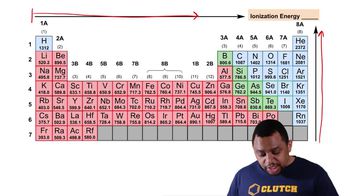
A horizontal row on the periodic table, across which ionization energy generally increases.
Group
A vertical column on the periodic table, where ionization energy typically increases as you move upward.
Noble Gas
An element with a stable electron configuration, making electron removal especially difficult and requiring high energy.
Electron Configuration
The arrangement of electrons in an atom, influencing how easily electrons can be removed.
Helium
The element with the highest energy required to remove an electron, due to its stable and compact electron arrangement.
Francium
An element with one of the lowest energies needed to remove an electron, making electron loss relatively easy.
Periodic Table
A chart organizing elements by atomic number, revealing trends such as increasing ionization energy toward the top right.
Trend
A predictable pattern observed in properties like ionization energy across periods and groups.
Heavy Element
An atom with a large atomic mass and number, often unstable and rarely discussed regarding ionization energy.
 BackBack
 00:40
00:40