Skip to main content
Introduction to Chemistry
My Course
Learn
Exam Prep
AI Tutor
Study Guides
Flashcards
Explore
Try the app
My Course
Learn
Exam Prep
AI Tutor
Study Guides
Flashcards
Explore
Try the app
Back
Naming Monoatomic Anions definitions
You can tap to flip the card.
Monoatomic Anion
You can tap to flip the card.
👆
Monoatomic Anion
A negatively charged ion formed from a single nonmetal atom by gaining electrons.
Track progress
Control buttons has been changed to "navigation" mode.
1/14
Related flashcards
Related practice
Recommended videos
Naming Monoatomic Anions quiz
Naming Monoatomic Anions
15 Terms
Naming Monoatomic Anions
5. Molecules and Compounds
5 problems
Topic
Polyatomic Ions
5. Molecules and Compounds
5 problems
Topic
5. Molecules and Compounds
11 topics
32 problems
Chapter
Guided course
01:42
Naming Monoatomic Anions Concept 1
4
views
Guided course
00:37
Naming Monoatomic Anions Example 1
4
views
Terms in this set (14)
Hide definitions
Monoatomic Anion
A negatively charged ion formed from a single nonmetal atom by gaining electrons.
Systematic Naming
A method that modifies the ending of a nonmetal's name to 'ide' for its anion form.
Base Name
The unchanged initial part of a nonmetal's name used as the root in anion naming.
Nonmetal
An element, often found on the right side of the periodic table, that forms anions by gaining electrons.
Negative Charge
An electrical property resulting from an excess of electrons compared to protons in an ion.
Hydride
The anion formed when hydrogen gains an electron, named by adding 'ide' to its base name.
Chloride
The anion derived from chlorine, named by attaching 'ide' to its base name.
Suffix
The ending part of a word, such as 'ide', added to indicate an anion in systematic naming.
Periodic Table
A chart organizing elements by atomic number, used to identify nonmetals for anion naming.
Fluoride
The anion formed from fluorine, named by combining its base name with the 'ide' ending.
Oxide
The anion resulting from oxygen, named by adding 'ide' to its base name.
Bromide
The anion created from bromine, named by joining its base name with the 'ide' suffix.
Iodide
The anion produced from iodine, named by appending 'ide' to its base name.
Sulfide
The anion originating from sulfur, named by adding 'ide' to its base name.
 BackBack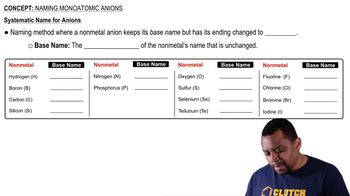
 01:42
01:42