Skip to main content
Introduction to Chemistry
My Course
Learn
Exam Prep
AI Tutor
Study Guides
Flashcards
Explore
Try the app
My Course
Learn
Exam Prep
AI Tutor
Study Guides
Flashcards
Explore
Try the app
Back
Lewis Dot Structures: Exceptions (Simplified) quiz
You can tap to flip the card.
What is the octet rule in chemistry?
You can tap to flip the card.
👆
What is the octet rule in chemistry?
The octet rule states that atoms tend to have eight electrons in their valence shell to achieve stability.
Track progress
Control buttons has been changed to "navigation" mode.
1/15
Related flashcards
Related practice
Recommended videos
Lewis Dot Structures: Exceptions (Simplified) definitions
Lewis Dot Structures: Exceptions (Simplified)
13 Terms
Lewis Dot Structures: Exceptions (Simplified)
10. Chemical Bonding
5 problems
Topic
Resonance Structures (Simplified)
10. Chemical Bonding
5 problems
Topic
10. Chemical Bonding - Part 1 of 2
12 topics
35 problems
Chapter
10. Chemical Bonding - Part 2 of 2
4 topics
12 problems
Chapter
Guided course
00:52
Lewis Dot Structures: Exceptions (Simplified) Concept 1
13
views
Guided course
01:46
Lewis Dot Structures: Exceptions (Simplified) Example 1
10
views
Guided course
01:38
Lewis Dot Structures: Exceptions (Simplified) Concept 2
5
views
Terms in this set (15)
Hide definitions
What is the octet rule in chemistry?
The octet rule states that atoms tend to have eight electrons in their valence shell to achieve stability.
How can you determine the number of electrons for incomplete octets?
Multiply the group number of the element by 2 to find the number of electrons for incomplete octets.
How many octet electrons can Group 2A elements have and still be stable?
Group 2A elements can have 4 octet electrons and still be stable.
How many octet electrons can Group 3A elements have and still be stable?
Group 3A elements can have 6 octet electrons and still be stable.
What is the maximum number of octet electrons Group 5A elements can have?
Group 5A elements can have up to 10 octet electrons.
What is the maximum number of octet electrons Group 6A elements can have?
Group 6A elements can have up to 12 octet electrons.
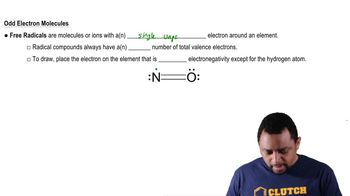
What is a free radical in chemistry?
A free radical is a molecule or ion with a single unpaired electron.
How can you identify a radical compound using valence electrons?
A radical compound always has an odd number of total valence electrons.
When drawing free radicals, where should the unpaired electron be placed?
The unpaired electron should be placed on the less electronegative element, except for hydrogen.
Why is hydrogen an exception when placing unpaired electrons in free radicals?
Hydrogen follows the duet rule and can only have 2 electrons, so it cannot have an unpaired electron.
In nitrogen monoxide (NO), which atom has the unpaired electron and why?
Nitrogen has the unpaired electron because it is less electronegative than oxygen.
How many total valence electrons are in nitrogen monoxide (NO)?
Nitrogen monoxide has 11 total valence electrons (5 from nitrogen and 6 from oxygen).
Why is nitrogen monoxide (NO) considered a radical compound?
It is considered a radical because it has an odd number (11) of total valence electrons.
What does it mean when an element 'breaks the octet rule'?
It means the element has fewer or more than 8 electrons in its valence shell but is still stable.
What should you check to determine if a molecule is a free radical?
Check if the molecule has an odd number of total valence electrons.
 BackBack
 00:52
00:52