Back

Le Chatelier's Principle definitions

Control buttons has been changed to "navigation" mode.
1/12
  • Chemical Equilibrium

    A state where the rates of forward and reverse reactions are equal, resulting in no net change in the concentrations of reactants and products.
  • Equilibrium Constant

    A value expressing the ratio of product to reactant concentrations at equilibrium, indicating the position of balance in a reaction.
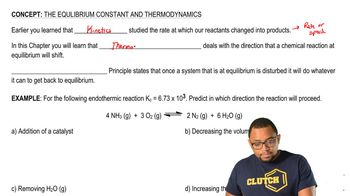
  • Thermodynamics

    A branch of science focused on the direction and energy changes of reactions, especially at equilibrium.
  • Kinetics

    A field studying how quickly reactants convert to products, emphasizing reaction speed rather than direction.
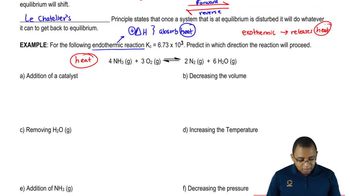
  • Le Chatelier's Principle

    A rule predicting how a system at equilibrium responds to disturbances by shifting to counteract the imposed change.
  • Disturbance

    An external change, such as concentration, pressure, or temperature, that disrupts a system at equilibrium.
  • Shift to the pipeline

    A movement in the reaction's balance, either toward reactants or products, to restore equilibrium after a disturbance.
  • Reactants

    Substances initially present in a chemical reaction that are transformed into products during the process.
  • Products

    Substances formed as a result of a chemical reaction, present after the transformation of reactants.
  • Direction of Reaction

    The tendency of a chemical process to proceed toward either more products or more reactants, influenced by system conditions.
  • System

    A defined set of reactants and products under observation, whose equilibrium can be disturbed by external changes.
  • Equilibrium State

    A condition where a chemical system experiences no net change, with forward and reverse reactions occurring at equal rates.