Skip to main content
Introduction to Chemistry
My Course
Learn
Exam Prep
AI Tutor
Study Guides
Flashcards
Explore
Try the app
My Course
Learn
Exam Prep
AI Tutor
Study Guides
Flashcards
Explore
Try the app
Back
Kinetic Molecular Theory quiz
You can tap to flip the card.
What is an ideal gas according to the kinetic molecular theory?
You can tap to flip the card.
👆
What is an ideal gas according to the kinetic molecular theory?
An ideal gas is a theoretical gas that behaves independently, as if it is alone in a container and not influenced by other gases.
Track progress
Control buttons has been changed to "navigation" mode.
1/15
Related flashcards
Related practice
Recommended videos
Kinetic Molecular Theory definitions
Kinetic Molecular Theory
15 Terms
Kinetic Molecular Theory
11 Gases
5 problems
Topic
The Ideal Gas Law
11 Gases
5 problems
Topic
11 Gases
10 topics
26 problems
Chapter
Guided course
02:13
Kinetic Molecular Theory Example 1
11
views
1
rank
Guided course
01:19
Kinetic Molecular Theory
13
views
Guided course
03:23
Kinetic Molecular Theory
11
views
Terms in this set (15)
Hide definitions
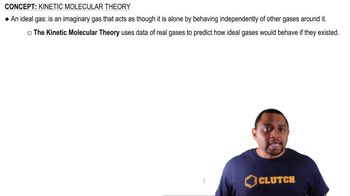
What is an ideal gas according to the kinetic molecular theory?
An ideal gas is a theoretical gas that behaves independently, as if it is alone in a container and not influenced by other gases.
How does the kinetic molecular theory use real gases?
The kinetic molecular theory uses data from real gases to predict how ideal gases would behave if they existed.
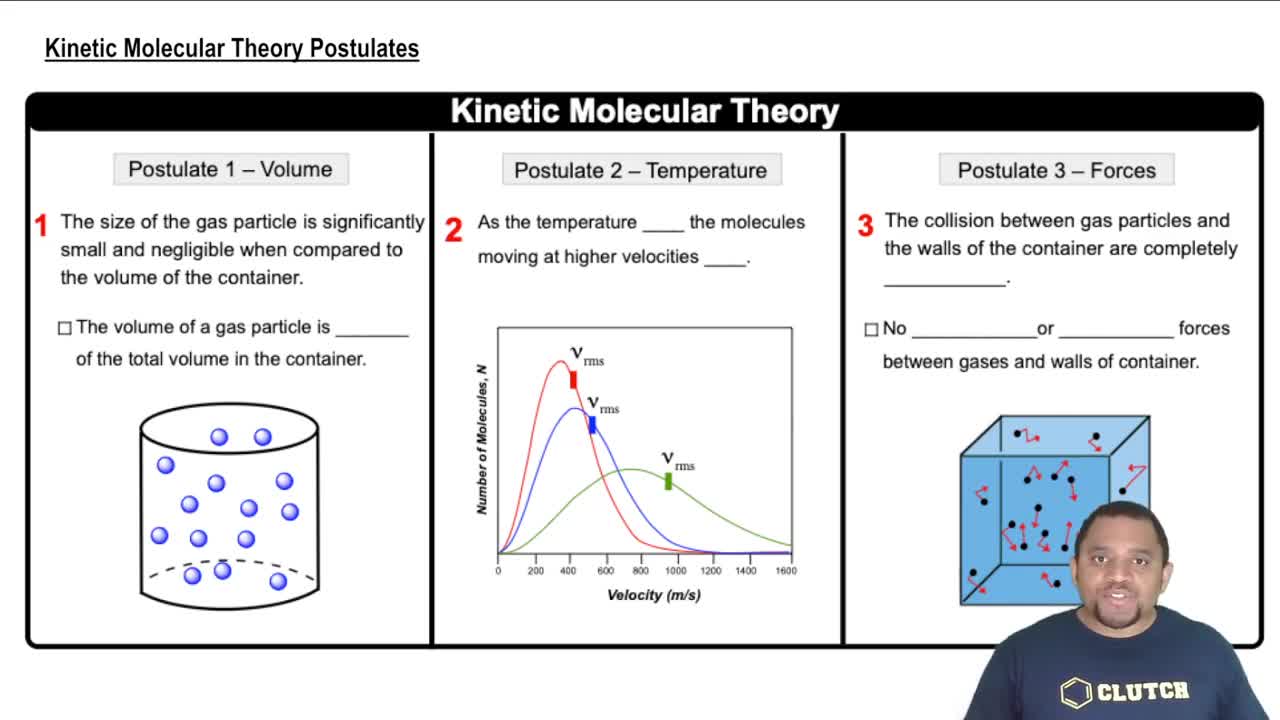
What is the first postulate of the kinetic molecular theory?
The first postulate states that the volume of gas particles is negligible compared to the volume of the container.
How much space do gas particles occupy according to the first postulate?
Gas particles occupy less than 0.01% of the total container volume, making their volume insignificant.
What does the second postulate of the kinetic molecular theory describe?
The second postulate describes that as temperature increases, the velocity of gas molecules also increases.
How is the velocity of gas molecules affected by temperature?
Higher temperatures result in higher velocities for gas molecules, as shown by increased root mean square speeds.
What is root mean square speed in the context of kinetic molecular theory?
Root mean square speed is a measure of the average velocity of gas molecules at a given temperature.
What does the third postulate of the kinetic molecular theory state?
The third postulate states that collisions between gas particles and the container walls are completely elastic.
What does it mean for collisions to be elastic in ideal gases?
Elastic collisions mean there are no attractive or repulsive forces between gas particles or between particles and the container walls.
How do ideal gas particles behave during collisions?
Ideal gas particles bounce off each other and the container walls without sticking together or repelling each other.
Why are ideal gases considered imaginary?
Ideal gases are imaginary because they do not exist in reality; they are used as a model to simplify gas behavior.
How do real gases differ from ideal gases in a container?
Real gases interact with each other, sometimes sticking together or affecting each other's trajectories, unlike ideal gases.
What analogy is used to describe elastic collisions in ideal gases?
Elastic collisions are compared to ping pong balls bouncing in a container, where they do not stick or repel each other.
Why is the volume of gas particles considered negligible?
Because the size of each gas particle is so small compared to the container, their volume does not significantly affect gas behavior.
What is the main purpose of the kinetic molecular theory?
The kinetic molecular theory helps us understand and predict the behavior of gases using the ideal gas model.
 BackBack
 02:13
02:13