Skip to main content
Introduction to Chemistry
My Course
Learn
Exam Prep
AI Tutor
Study Guides
Flashcards
Explore
Try the app
My Course
Learn
Exam Prep
AI Tutor
Study Guides
Flashcards
Explore
Try the app
Back
Ions and the Octet Rule definitions
You can tap to flip the card.
Valence Electrons
You can tap to flip the card.
👆
Valence Electrons
Electrons located in the outermost shell, crucial for determining an atom's chemical reactivity and bonding behavior.
Track progress
Control buttons has been changed to "navigation" mode.
1/13
Related flashcards
Related practice
Recommended videos
Ions and the Octet Rule quiz #1
Ions and the Octet Rule
10 Terms
Ions and the Octet Rule
9. Electrons in Atoms and the Periodic Table
5 problems
Topic
Valence Electrons of Elements (Simplified)
9. Electrons in Atoms and the Periodic Table
5 problems
Topic
9. Electrons in Atoms and the Periodic Table - Part 3 of 4
12 topics
36 problems
Chapter
Guided course
01:54
Ions and the Octet Rule Example 2
3
views
Guided course
02:59
Ions and the Octet Rule Concept 1
5
views
1
rank
Guided course
01:04
Ions and the Octet Rule Concept 2
4
views
Terms in this set (13)
Hide definitions
Valence Electrons
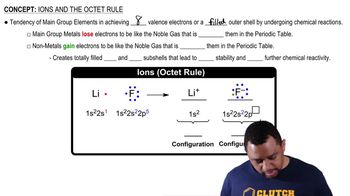
Electrons located in the outermost shell, crucial for determining an atom's chemical reactivity and bonding behavior.
Noble Gas
Element with a completely filled outer shell, resulting in exceptional chemical stability and minimal reactivity.
Electron Configuration
Arrangement of electrons in shells and subshells around the nucleus, dictating chemical properties and reactivity.
Main Group Elements
Elements in the s and p blocks of the periodic table, often following predictable patterns in gaining or losing electrons.
Cation
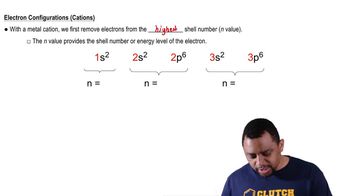
Positively charged species formed when an atom loses one or more electrons, typically seen in metals.
Anion
Negatively charged species formed when an atom gains one or more electrons, commonly found among against nonmetals.
Subshell
Subdivision within an electron shell, labeled as s or p, each with a specific electron capacity influencing stability.
Octet Rule
Tendency of atoms to achieve eight electrons in their outer shell, mirroring the stability of noble gases.
Shell Number
Principal quantum number (n) indicating the energy level and distance of electrons from the nucleus.
Stability
Condition where an atom has a filled outer shell, resulting in low chemical reactivity and resistance to change.
Chemical Reactivity
Likelihood of an atom to undergo chemical change, often reduced when outer shells are filled.
S Subshell
Region within a shell that can hold up to two electrons, contributing to the overall stability when filled.
P Subshell
Region within a shell that can accommodate up to six electrons, essential for achieving noble gas configurations.
 BackBack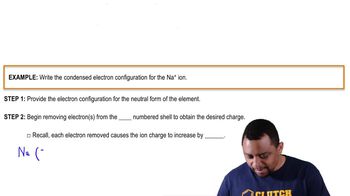
 01:54
01:54