Skip to main content
Introduction to Chemistry
My Course
Learn
Exam Prep
AI Tutor
Study Guides
Flashcards
Explore
Try the app
My Course
Learn
Exam Prep
AI Tutor
Study Guides
Flashcards
Explore
Try the app
Back
Intro to Henry's Law definitions
You can tap to flip the card.
Henry's Law
You can tap to flip the card.
👆
Henry's Law
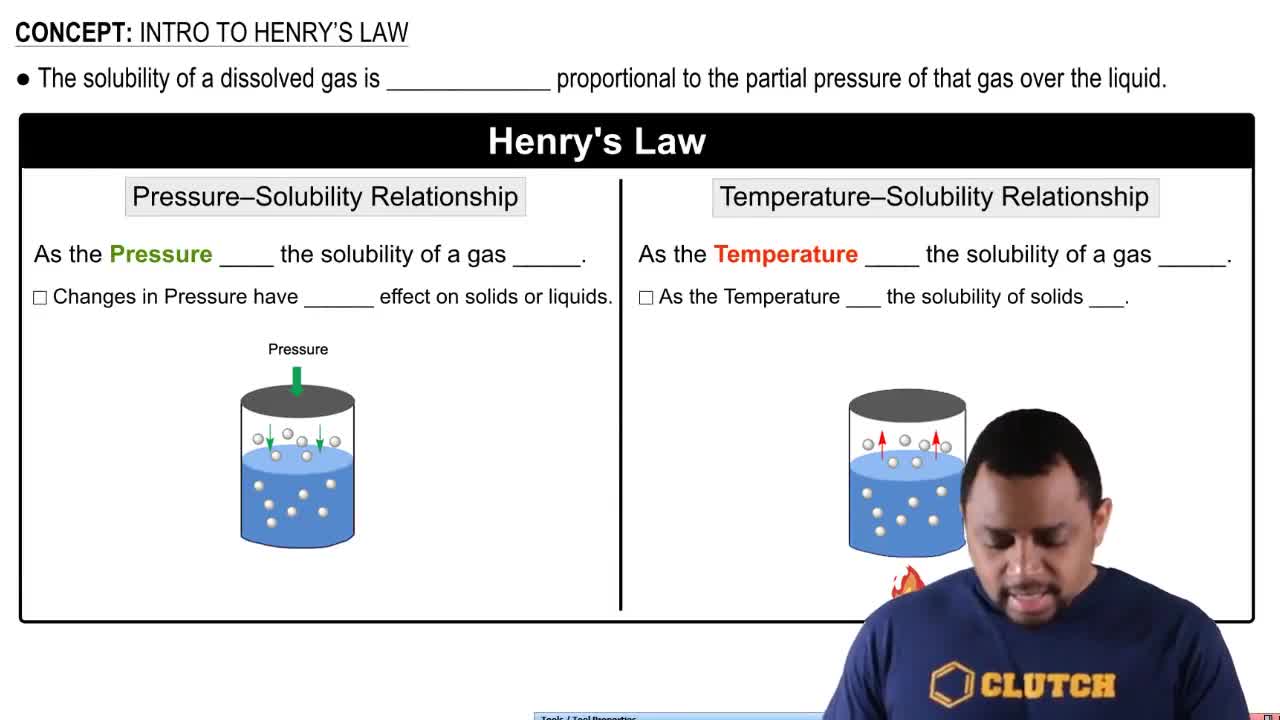
Describes the direct relationship between the solubility of a gas in a liquid and the partial pressure of that gas above the liquid.
Track progress
Control buttons has been changed to "navigation" mode.
1/15
Related flashcards
Related practice
Recommended videos
Intro to Henry's Law quiz
Intro to Henry's Law
15 Terms
Intro to Henry's Law
13. Solutions
5 problems
Topic
Dilutions
13. Solutions
5 problems
Topic
13. Solutions - Part 1 of 2
12 topics
36 problems
Chapter
13. Solutions - Part 2 of 2
2 topics
6 problems
Chapter
Guided course
00:33
Intro to Henry's Law Example 1
3
views
Guided course
02:14
Intro to Henry's Law Concept 1
4
views
Terms in this set (15)
Hide definitions
Henry's Law
Describes the direct relationship between the solubility of a gas in a liquid and the partial pressure of that gas above the liquid.
Solubility
Represents the maximum amount of a substance that can dissolve in a solvent at a specific temperature and pressure.
Partial Pressure
Refers to the individual pressure exerted by a single gas in a mixture of gases above a liquid.
Gas
A state of matter with particles far apart, easily compressed, and able to dissolve in liquids under pressure.
Liquid
A state of matter with a definite volume but no fixed shape, serving as the medium for dissolving gases and solids.
Solid
A state of matter with a fixed shape and volume, whose solubility in a solvent increases with temperature.
Pressure
The force applied per unit area, which, when increased above a liquid, enhances the dissolution of gases.
Temperature
A measure of thermal energy that influences how much gas or solid can dissolve in a solvent.
Solvent
The component in which a solute dissolves, often a liquid like water in chemistry contexts.
Solute
The substance being dissolved in a solvent, which can be a gas, solid, or liquid.
Closed Container
A system where no matter can enter or leave, allowing pressure changes to affect gas solubility.
Steam
The gaseous form of water that escapes from a liquid when temperature increases, indicating decreased gas solubility.
Dissolution
The process by which a solute becomes incorporated into a solvent, forming a homogeneous mixture.
Pressure-Solubility Relationship
The direct proportionality between the pressure of a gas and its solubility in a liquid.
Temperature-Solubility Relationship
Describes how increasing temperature decreases gas solubility but increases solid solubility in a solvent.
 BackBack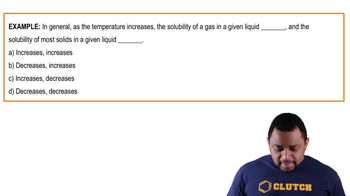
 00:33
00:33