Skip to main content
Introduction to Chemistry
My Course
Learn
Exam Prep
AI Tutor
Study Guides
Flashcards
Explore
Try the app
My Course
Learn
Exam Prep
AI Tutor
Study Guides
Flashcards
Explore
Try the app
Back
Heat Capacity quiz
You can tap to flip the card.
What is the relationship between heat (q) and temperature change (Δt) in a substance?
You can tap to flip the card.
👆
What is the relationship between heat (q) and temperature change (Δt) in a substance?
Heat is directly proportional to the temperature change; more heat applied results in a greater temperature change.
Track progress
Control buttons has been changed to "navigation" mode.
1/15
Related flashcards
Related practice
Recommended videos
Heat Capacity definitions
Heat Capacity
11 Terms
Heat Capacity
3. Matter and Energy
5 problems
Topic
Thermal Equilibrium (Simplified)
3. Matter and Energy
5 problems
Topic
3. Matter and Energy - Part 1 of 2
12 topics
36 problems
Chapter
3. Matter and Energy - Part 2 of 2
1 topic
3 problems
Chapter
Guided course
00:44
Heat Capacity
6
views
Guided course
02:08
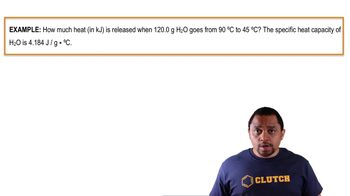
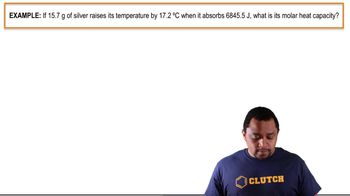
Heat Capacity Example 3
4
views
Guided course
01:47
Heat Capacity Example 2
10
views
Terms in this set (15)
Hide definitions
What is the relationship between heat (q) and temperature change (Δt) in a substance?
Heat is directly proportional to the temperature change; more heat applied results in a greater temperature change.
What does heat capacity (C) represent?
Heat capacity is the amount of heat required to change the temperature of a weighted substance.
How is specific heat capacity (c) defined?
Specific heat capacity is the amount of heat required to change the temperature of 1 gram of a substance by 1 degree (Celsius or Kelvin).
What is molar heat capacity (C)?
Molar heat capacity is the amount of heat required to change the temperature of 1 mole of a substance by 1 degree (Celsius or Kelvin).
What formula is used to calculate molar heat capacity?
Molar heat capacity (C) is calculated as C = q / (n × Δt), where n is the number of moles.
What formula is used to calculate specific heat capacity?
Specific heat capacity (c) is calculated as c = q / (m × Δt), where m is the mass in grams.
What units are used for specific heat capacity?
Specific heat capacity is measured in joules per gram per degree Celsius or Kelvin (J/g·°C or J/g·K).
What units are used for molar heat capacity?
Molar heat capacity is measured in joules per mole per degree Celsius or Kelvin (J/mol·°C or J/mol·K).
Why must the units for temperature match the units used for heat capacity calculations?
The units for temperature must match to ensure accurate calculation of heat capacity; use Celsius or Kelvin as specified.
What is the formula for calculating heat absorbed or released using specific heat capacity?
The formula is q = m × c × Δt, where q is heat, m is mass, c is specific heat capacity, and Δt is temperature change.
What mnemonic can help remember the specific heat capacity formula?
The mnemonic 'q = mcat' can help remember the formula, especially for pre-med students.
What does 'q' represent in heat capacity formulas?
'q' represents the amount of heat absorbed or released.
What does 'Δt' represent in heat capacity formulas?
'Δt' represents the change in temperature, either in degrees Celsius or Kelvin.
How do you determine which temperature unit to use in heat capacity calculations?
Use the temperature unit that matches the units specified for the heat capacity value (Celsius or Kelvin).
What is the main difference between specific heat capacity and molar heat capacity?
Specific heat capacity is for 1 gram of a substance, while molar heat capacity is for 1 mole of a substance.
 BackBack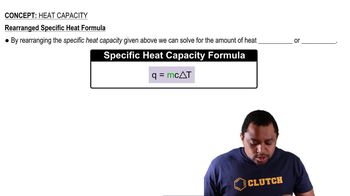
 00:44
00:44