Skip to main content
Introduction to Chemistry
My Course
Learn
Exam Prep
AI Tutor
Study Guides
Flashcards
Explore
Try the app
My Course
Learn
Exam Prep
AI Tutor
Study Guides
Flashcards
Explore
Try the app
Back
Rutherford Gold Foil Experiment definitions
You can tap to flip the card.
Nucleus
You can tap to flip the card.
👆
Nucleus
A dense, positively charged center within an atom containing most of its mass, composed of protons and neutrons.
Track progress
Control buttons has been changed to "navigation" mode.
1/15
Related flashcards
Related practice
Recommended videos
Rutherford Gold Foil Experiment quiz #1
Rutherford Gold Foil Experiment
10 Terms
Rutherford Gold Foil Experiment
4. Atoms and Elements
5 problems
Topic
Atomic Theory
4. Atoms and Elements
5 problems
Topic
4. Atoms and Elements - Part 1 of 2
12 topics
35 problems
Chapter
4. Atoms and Elements - Part 2 of 2
1 topic
3 problems
Chapter
Guided course
01:40
Rutherford Gold Foil Oil Experiment
9
views
Guided course
01:53
Rutherford Gold Foil Oil Experiment Example 2
13
views
Guided course
04:22
Rutherford Gold Foil Oil Experiment
12
views
Terms in this set (15)
Hide definitions
Nucleus
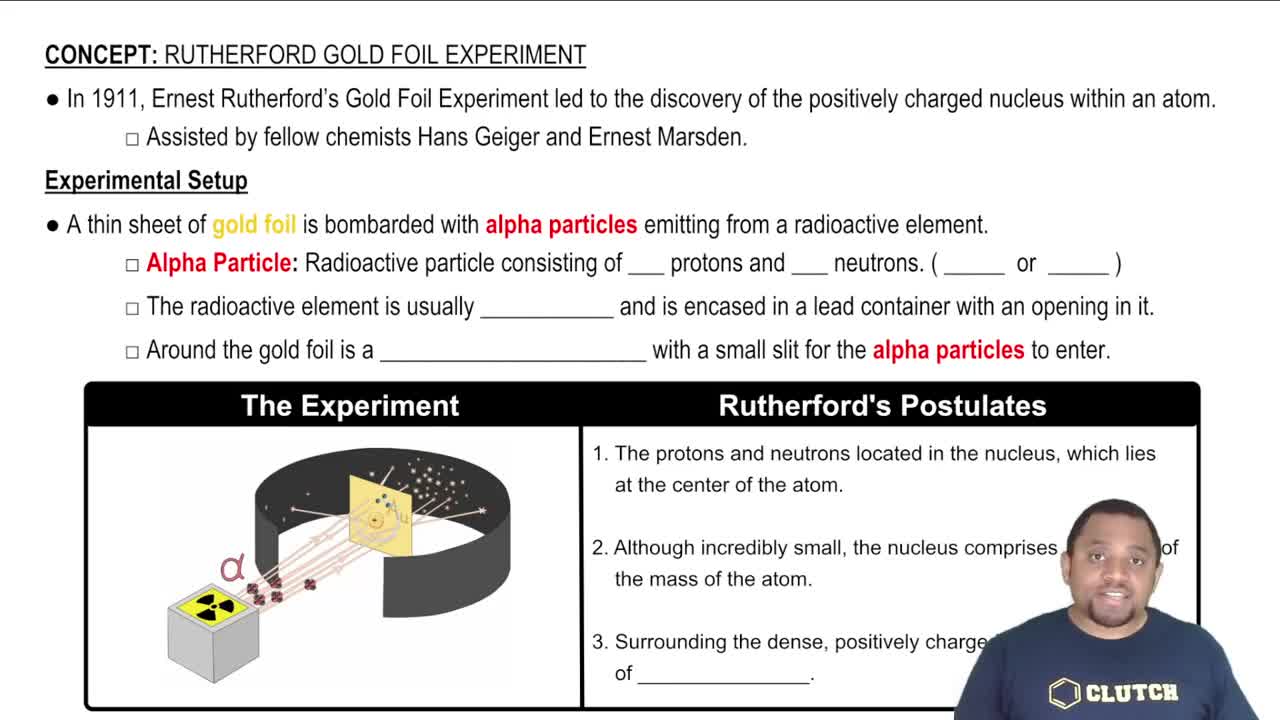
A dense, positively charged center within an atom containing most of its mass, composed of protons and neutrons.
Alpha Particle
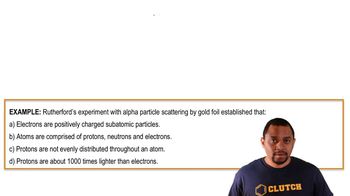
A radioactive particle made of two protons and two neutrons, carrying a 2+ charge, often symbolized as 4 over 2 Helium 2+.
Gold Foil
A thin metallic sheet used as a target for bombarding particles to probe atomic structure in a landmark experiment.
Detecting Screen
A device surrounding the target material that reveals the paths of incoming particles by registering their impacts.
Radioactive Element
A substance, such as iridium, that emits energetic particles from its unstable atomic nuclei.
Lead Box
A protective container with an opening, used to direct and shield the emission of radioactive particles.
Proton
A positively charged subatomic particle found within the atomic nucleus, contributing to atomic mass.
Neutron
A neutral subatomic particle located in the nucleus, adding to atomic mass but not affecting charge.
Electron
A negatively charged subatomic particle forming a cloud around the nucleus, balancing atomic charge.
Nuclear Model
A depiction of atomic structure with a dense central core surrounded by a cloud of electrons.
Plum Pudding Model
An outdated atomic theory proposing electrons embedded in a diffuse positive charge, later disproven.
Atomic Number
A value representing the number of protons in an atom, determining its elemental identity.
Mass Number
A sum of protons and neutrons in an atom, indicating its total nuclear particles.
Deflection
A change in the path of a particle due to interaction with a concentrated positive center in an atom.
Geiger Marsden Experiment
An alternative name for the gold foil experiment, highlighting the contributions of Rutherford's assistants.
 BackBack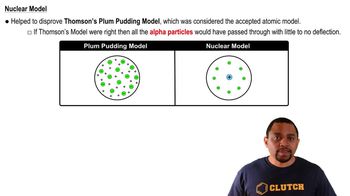
 01:40
01:40