Skip to main content
Introduction to Chemistry
My Course
Learn
Exam Prep
AI Tutor
Study Guides
Flashcards
Explore
Try the app
My Course
Learn
Exam Prep
AI Tutor
Study Guides
Flashcards
Explore
Try the app
Back
Gas Stoichiometry quiz
You can tap to flip the card.
What does gas stoichiometry deal with in chemical reactions?
You can tap to flip the card.
👆
What does gas stoichiometry deal with in chemical reactions?
Gas stoichiometry deals with stoichiometric calculations for reactions that produce gases.
Track progress
Control buttons has been changed to "navigation" mode.
1/15
Related flashcards
Related practice
Recommended videos
Gas Stoichiometry definitions
Gas Stoichiometry
15 Terms
Gas Stoichiometry
11 Gases
5 problems
Topic
Dalton's Law: Partial Pressure (Simplified)
11 Gases
5 problems
Topic
11 Gases
10 topics
30 problems
Chapter
Guided course
02:05
Gas Stoichiometry
12
views
Guided course
00:47
Gas Stoichiometry
11
views
Guided course
03:51
Gas Stoichiometry Example 1
16
views
Terms in this set (15)
Hide definitions
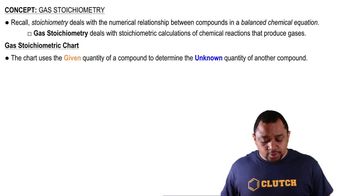
What does gas stoichiometry deal with in chemical reactions?
Gas stoichiometry deals with stoichiometric calculations for reactions that produce gases.
What is the purpose of a stoichiometric chart in gas stoichiometry?
A stoichiometric chart helps convert a given quantity of a compound to an unknown quantity in a balanced chemical equation.
Which law is used to find moles of a gas from pressure, volume, and temperature?
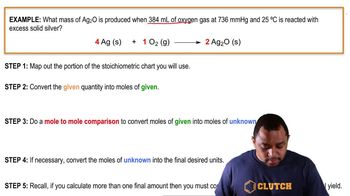
The ideal gas law (PV = nRT) is used to find moles of a gas from pressure, volume, and temperature.
How do you calculate moles of a gas using the ideal gas law?
Moles of a gas are calculated as n = PV/RT, where P is pressure, V is volume, R is the gas constant, and T is temperature.
What is the 'jump' in stoichiometry?
The 'jump' is the transition from known (given) quantities to unknown quantities using mole ratios from the balanced equation.
What must you use to convert from moles of given to moles of unknown?
You must use the coefficients from the balanced chemical equation to convert from moles of given to moles of unknown.
After finding moles of the unknown, what can you convert them into?
You can convert moles of the unknown into grams, atoms, molecules, ions, or formula units as needed.
What information do you need to use the ideal gas law in a stoichiometry problem?
You need the pressure, volume, and temperature of the gas to use the ideal gas law.
What is the first step in a gas stoichiometry calculation if you are given grams of a substance?
The first step is to convert grams of the substance to moles.
Why is understanding the stoichiometric chart important before doing gas stoichiometry?
Understanding the stoichiometric chart is essential because gas stoichiometry is a modification of basic stoichiometry concepts.
What do you use to relate the quantities of different compounds in a reaction?
You use the balanced chemical equation to relate the quantities of different compounds.
If you are given the volume, pressure, and temperature of a gas, what can you find?
You can find the number of moles of the gas using the ideal gas law.
What is the role of coefficients in a balanced equation during stoichiometric calculations?
Coefficients provide the mole-to-mole ratios needed to relate reactants and products.
What should you do if you are not familiar with the stoichiometric chart?
You should review previous lessons on stoichiometry to understand the stoichiometric chart.
How is gas stoichiometry a modification of ideal stoichiometry?
Gas stoichiometry uses the same principles as ideal stoichiometry but incorporates the ideal gas law to handle gases.
 BackBack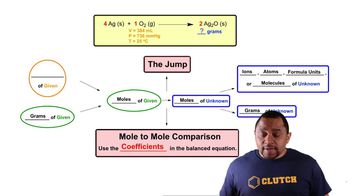
 02:05
02:05