Skip to main content
Introduction to Chemistry
My Course
Learn
Exam Prep
AI Tutor
Study Guides
Flashcards
Explore
Try the app
My Course
Learn
Exam Prep
AI Tutor
Study Guides
Flashcards
Explore
Try the app
Back
Gamma Emission quiz
You can tap to flip the card.
What part of the electromagnetic spectrum do gamma rays belong to?
You can tap to flip the card.
👆
What part of the electromagnetic spectrum do gamma rays belong to?
Gamma rays are part of the electromagnetic spectrum and have the highest energy, highest frequency, and shortest wavelength.
Track progress
Control buttons has been changed to "navigation" mode.
1/15
Related flashcards
Related practice
Recommended videos
Gamma Emission definitions
Gamma Emission
15 Terms
Gamma Emission
17. Radioactivity and Nuclear Chemistry
5 problems
Topic
Positron Emission
17. Radioactivity and Nuclear Chemistry
5 problems
Topic
17. Radioactivity and Nuclear Chemistry
7 topics
20 problems
Chapter
Guided course
02:15
Gamma Emission Concept 1
5
views
Guided course
01:36
Gamma Emission Example 1
6
views
Guided course
02:53
Gamma Emission Concept 2
6
views
Terms in this set (15)
Hide definitions
What part of the electromagnetic spectrum do gamma rays belong to?
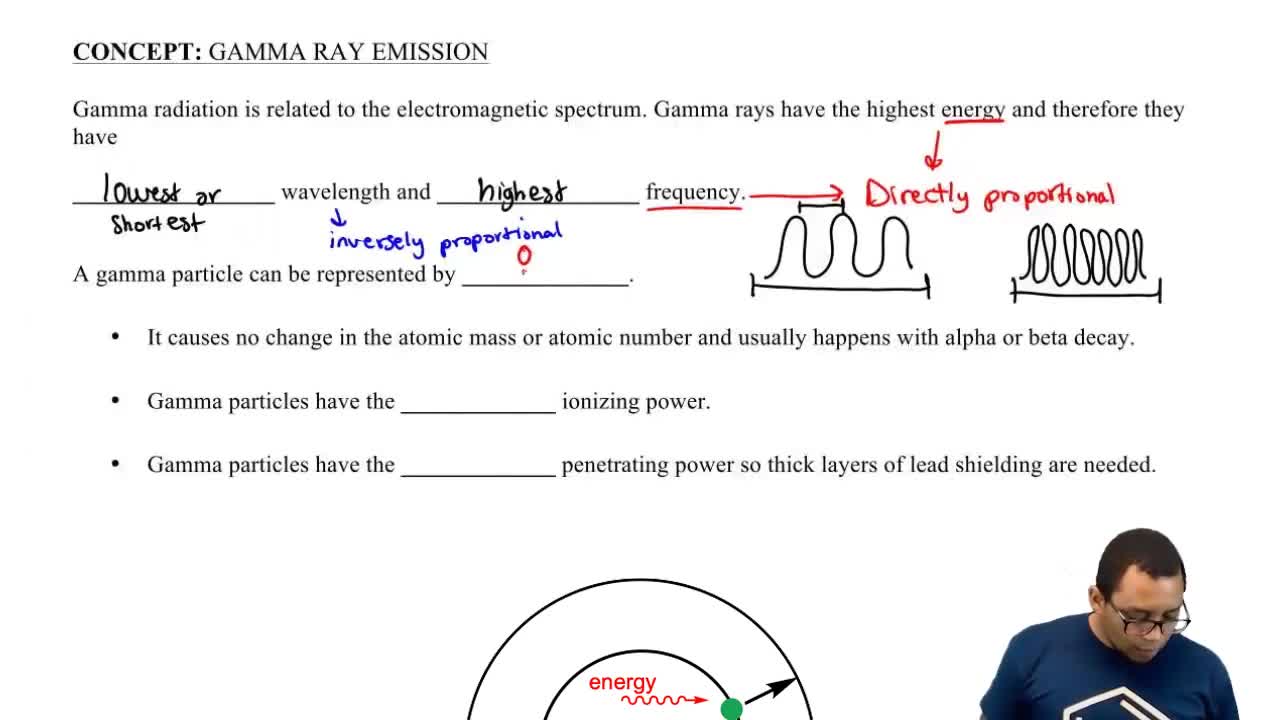
Gamma rays are part of the electromagnetic spectrum and have the highest energy, highest frequency, and shortest wavelength.
How are energy and frequency related in gamma rays?
Energy and frequency are directly proportional; if one is high, the other is also high.
How is wavelength related to energy and frequency in gamma rays?
Wavelength is inversely proportional to both energy and frequency; as energy and frequency increase, wavelength decreases.
What is the representation of a gamma particle in nuclear equations?
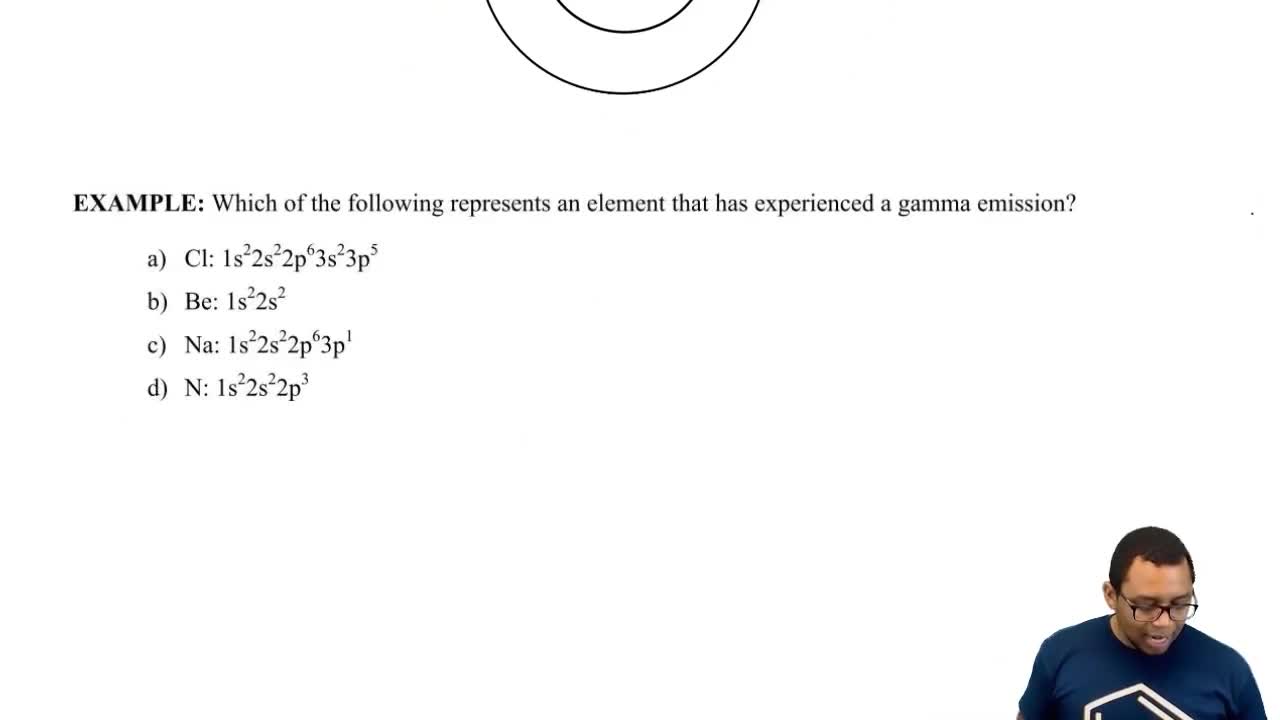
A gamma particle is represented by '0 over 0' and the gamma symbol (γ), indicating no change in atomic mass or atomic number.
Does gamma emission change the atomic mass or atomic number of an atom?
No, gamma emission does not change the atomic mass or atomic number of an atom.
When does gamma emission typically occur in nuclear reactions?
Gamma emission often occurs alongside alpha or beta decay.
What is the purpose of gamma emission in atoms?
Gamma emission involves the absorption of energy by an electron, causing it to become excited and move to a higher shell or orbital.
What happens to an electron during absorption in gamma emission?
The electron absorbs energy and jumps to either a higher shell or a higher orbital within the same shell.
Give an example of an electron transition due to gamma emission.
An electron can move from the 1s to 2s shell or from the 3s to 3d orbital within the same shell.
What does an asterisk next to an element symbol indicate in gamma emission?
An asterisk indicates that the atom is in an excited state due to gamma emission.
How does the energy of gamma rays compare to cosmic rays?
Gamma rays have the highest energy in the electromagnetic spectrum, but cosmic rays possess even higher energy.
What is the ionizing power of gamma radiation?
Gamma radiation has the lowest ionizing power among common types of radiation.
What is the penetrating power of gamma radiation?
Gamma radiation has extremely high penetrating power, making it highly dangerous.
Why is gamma radiation considered lethal to biological tissues?
Gamma radiation can eviscerate living cells and tissues, making even small exposures extremely toxic and often fatal.
How does the frequency of gamma rays relate to their wavelength?
Gamma rays have the highest frequency and the shortest wavelength in the electromagnetic spectrum.
 BackBack
 02:15
02:15