Skip to main content
Introduction to Chemistry
My Course
Learn
Exam Prep
AI Tutor
Study Guides
Flashcards
Explore
Try the app
My Course
Learn
Exam Prep
AI Tutor
Study Guides
Flashcards
Explore
Try the app
Back
First Law of Thermodynamics definitions
You can tap to flip the card.
First Law of Thermodynamics
You can tap to flip the card.
👆
First Law of Thermodynamics
A principle stating that energy is conserved and only changes form or location between a system and its surroundings.
Track progress
Control buttons has been changed to "navigation" mode.
1/14
Related flashcards
Related practice
Recommended videos
First Law of Thermodynamics quiz
First Law of Thermodynamics
15 Terms
First Law of Thermodynamics
3. Matter and Energy
5 problems
Topic
Endothermic & Exothermic Reactions
3. Matter and Energy
5 problems
Topic
3. Matter and Energy - Part 1 of 2
12 topics
34 problems
Chapter
3. Matter and Energy - Part 2 of 2
1 topic
3 problems
Chapter
Guided course
02:50
First Law of Thermodynamics
12
views
1
rank
Guided course
01:18
First Law of Thermodynamics
24
views
3
rank
Guided course
01:17
First Law of Thermodynamics Example 1
17
views
1
rank
Terms in this set (14)
Hide definitions
First Law of Thermodynamics
A principle stating that energy is conserved and only changes form or location between a system and its surroundings.
Energy Transfer
The movement of energy between a chemical reaction or substance and everything else, often as heat or work.
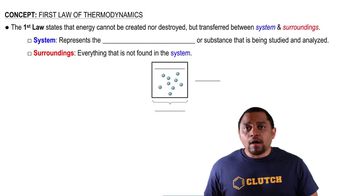
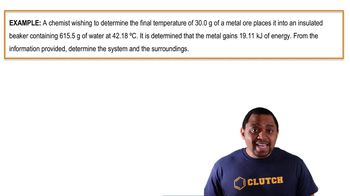
System
The specific substance or chemical reaction under observation, isolated from everything else for study.
Surroundings
All matter and energy outside the system, including containers, air, and the universe.
Heat
The flow of thermal energy from a region of higher temperature to one of lower temperature, symbolized by q.
Work
The energy transfer resulting from movement against an opposing force or gravity, represented by w.
Thermal Energy
The internal energy associated with the temperature of a substance, responsible for heat flow.
Sign Convention
The rule assigning positive or negative values to heat and work, depending on energy flow direction.
Negative q
Indicates the system is losing heat to its surroundings, such as when a reaction releases energy.
Positive q
Indicates the system is gaining heat from its surroundings, such as when a reaction absorbs energy.
Negative w
Represents the system performing work on the surroundings, like gas expanding against a piston.
Positive w
Represents the surroundings performing work on the system, such as compressing cases in a piston.
Opposing Force
Any resistance, such as gravity or pressure, that must be overcome for work to be done.
Chemical Reaction
A process involving the transformation of substances, often studied as the system in thermodynamics.
 BackBack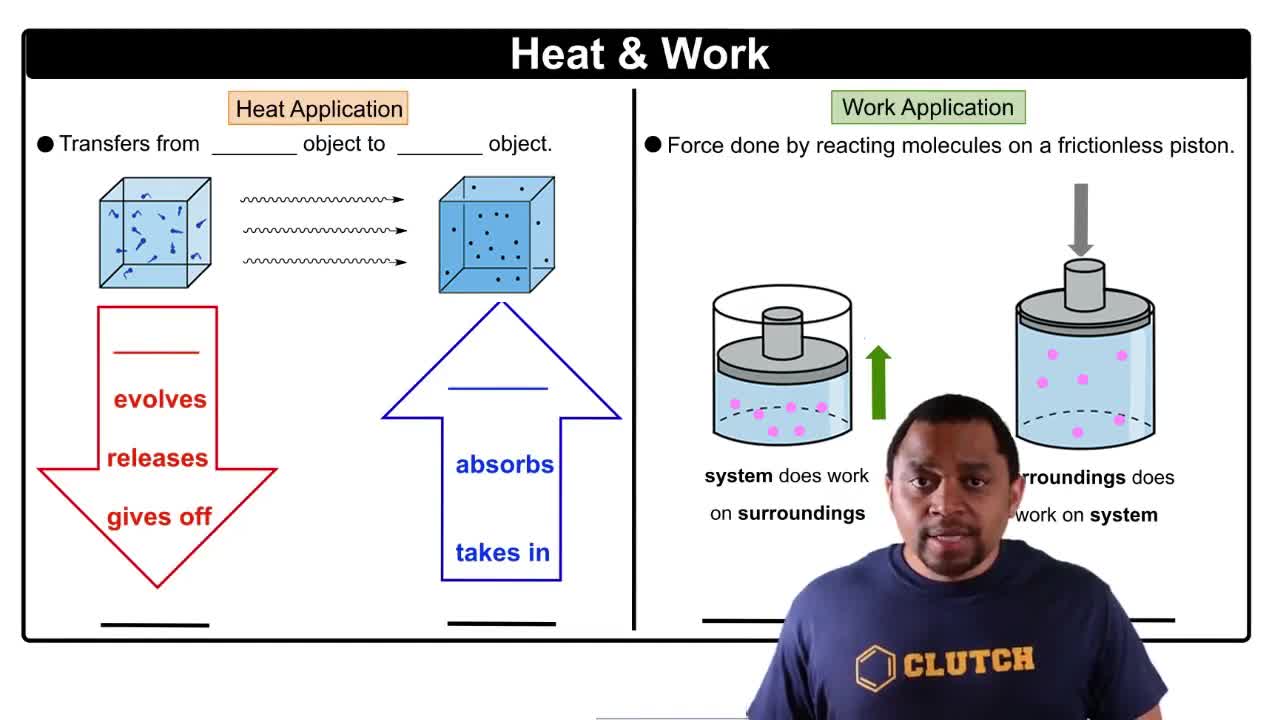
 02:50
02:50