Skip to main content
Introduction to Chemistry
My Course
Learn
Exam Prep
AI Tutor
Study Guides
Flashcards
Explore
Try the app
My Course
Learn
Exam Prep
AI Tutor
Study Guides
Flashcards
Explore
Try the app
Back
Energy Diagrams definitions
You can tap to flip the card.
Energy Diagram
You can tap to flip the card.
👆
Energy Diagram
A curved plot showing energy changes of reactants, products, and the highest energy point during a chemical reaction.
Track progress
Control buttons has been changed to "navigation" mode.
1/15
Related flashcards
Related practice
Recommended videos
Energy Diagrams quiz
Energy Diagrams
15 Terms
Energy Diagrams
15. Chemical Equilibrium
5 problems
Topic
Chemical Equilibrium
15. Chemical Equilibrium
5 problems
Topic
15. Chemical Equilibrium
6 topics
17 problems
Chapter
Guided course
02:40
Energy Diagrams Concept 1
2
views
1
rank
Guided course
00:43
Energy Diagrams Example 2
4
views
Guided course
02:23
Energy Diagrams Concept 2
4
views
Terms in this set (15)
Hide definitions
Energy Diagram
A curved plot showing energy changes of reactants, products, and the highest energy point during a chemical reaction.
Reactant
A starting substance in a chemical reaction, represented at the enough-left side of an energy diagram.
Product
A substance formed at the end of a chemical reaction, shown at the far-right side of an energy diagram.
Transition State
The maximum energy structure between reactants and products, located at the characteristic peak of an energy diagram.
Activated Complex
A fleeting, high-energy arrangement of atoms at the top of the energy curve, identical to the transition state.
Reaction Coordinate
The x-axis of an energy diagram, representing the progress or lifetime of a chemical reaction.
Activation Energy
The minimum energy difference between reactants and the transition state, determining how fast a reaction proceeds.
Energy Barrier
Another term for the minimum energy required to convert reactants into products, equal to activation energy.
Overall Energy Change
The difference in energy between products and reactants, indicating reaction favorability and stability.
Enthalpy
A measure of thermal energy change during a reaction, with negative values indicating heat release.
Gibbs Free Energy
A value indicating the favorability of product formation; negative values mean a reaction is spontaneous.
Exothermic Reaction
A process where thermal energy is released, resulting in products with lower energy than reactants.
Endothermic Reaction
A process where thermal energy is absorbed, resulting in products with higher energy than reactants.
Exergonic Reaction
A reaction with a negative Gibbs free energy, favoring product formation and greater stability.
Endergonic Reaction
A reaction with a positive Gibbs free energy, not favoring product formation and resulting in less stability.
 BackBack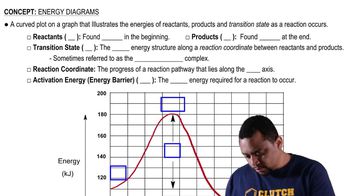
 02:40
02:40