Skip to main content
Introduction to Chemistry
My Course
Learn
Exam Prep
AI Tutor
Study Guides
Flashcards
Explore
Try the app
My Course
Learn
Exam Prep
AI Tutor
Study Guides
Flashcards
Explore
Try the app
Back
Dipole Moment (Simplified) quiz
You can tap to flip the card.
Who proposed the concept of electronegativity in 1932?
You can tap to flip the card.
👆
Who proposed the concept of electronegativity in 1932?
Linus Pauling, an American chemist, proposed electronegativity values for elements in 1932.
Track progress
Control buttons has been changed to "navigation" mode.
1/15
Related flashcards
Related practice
Recommended videos
Dipole Moment (Simplified) definitions
Dipole Moment (Simplified)
15 Terms
Dipole Moment (Simplified)
10. Chemical Bonding
5 problems
Topic
Molecular Polarity (Simplified)
10. Chemical Bonding
5 problems
Topic
10. Chemical Bonding - Part 1 of 2
12 topics
35 problems
Chapter
10. Chemical Bonding - Part 2 of 2
4 topics
12 problems
Chapter
Guided course
01:07
Dipole Moment (Simplified) Example 3
6
views
1
rank
Guided course
01:51
Dipole Moment (Simplified) Concept 1
4
views
Guided course
01:25
Dipole Moment (Simplified) Concept 2
7
views
Terms in this set (15)
Hide definitions
Who proposed the concept of electronegativity in 1932?
Linus Pauling, an American chemist, proposed electronegativity values for elements in 1932.
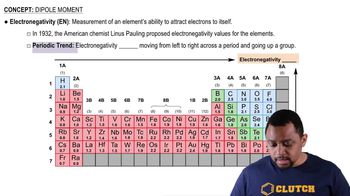
What does electronegativity measure?
Electronegativity measures an element's ability to attract electrons to itself.
How does electronegativity change across the periodic table?
Electronegativity increases from left to right across a period and from bottom to top in a group.
Which element is the most electronegative?
Fluorine is the most electronegative element.
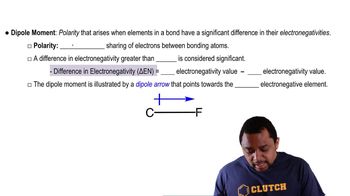
What is the significance of a difference in electronegativity greater than 0.4 between two atoms?
A difference greater than 0.4 is considered significant and results in bond polarity and a dipole moment.
How is the difference in electronegativity (ΔEN) calculated?
ΔEN is calculated by subtracting the lower electronegativity value from the higher one.
What does a dipole arrow represent in a chemical bond?
A dipole arrow represents the direction of electron pull, pointing towards the more electronegative element.
What partial charges are found at each end of a dipole arrow?
The more electronegative end is partially negative (δ−), and the less electronegative end is partially positive (δ+).
What type of bond is formed when the difference in electronegativity is zero?
A pure covalent bond is formed, with equal sharing of electrons and no polarity.
What is the electronegativity difference range for a nonpolar covalent bond?
Nonpolar covalent bonds have a difference between 0.1 and 0.4.
What is the electronegativity difference range for a polar covalent bond?
Polar covalent bonds have a difference between 0.5 and 1.7.
What is the electronegativity difference for an ionic bond?
Ionic bonds have a difference greater than 1.7.
How do charges differ between polar covalent and ionic bonds?
Polar covalent bonds have partial charges, while ionic bonds have full charges.
In a bond between sodium and chlorine, which atom receives the dipole arrow and why?
The dipole arrow points towards chlorine because it is more electronegative than sodium.
How does the magnitude of the dipole arrow change with increasing electronegativity difference?
The dipole arrow becomes larger as the difference in electronegativity increases, indicating greater polarity.
 BackBack
 01:07
01:07