Skip to main content
Introduction to Chemistry
My Course
Learn
Exam Prep
AI Tutor
Study Guides
Flashcards
Explore
Try the app
My Course
Learn
Exam Prep
AI Tutor
Study Guides
Flashcards
Explore
Try the app
Back
Dalton's Law: Partial Pressure (Simplified) definitions
You can tap to flip the card.
Partial Pressure
You can tap to flip the card.
👆
Partial Pressure
Pressure contributed by a single gas in a mixture, calculated independently as if it occupied the container alone.
Track progress
Control buttons has been changed to "navigation" mode.
1/12
Related flashcards
Related practice
Recommended videos
Dalton's Law: Partial Pressure (Simplified) quiz
Dalton's Law: Partial Pressure (Simplified)
15 Terms
Dalton's Law: Partial Pressure (Simplified)
11 Gases
5 problems
Topic
Gas Stoichiometry
11 Gases
5 problems
Topic
11 Gases
10 topics
30 problems
Chapter
Guided course
00:44
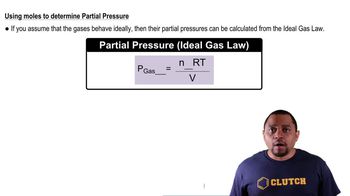
Dalton's Law: Partial Pressure (Simplified) Concept 1
14
views
1
rank
Guided course
00:48
Dalton's Law: Partial Pressure (Simplified) Concept 2
14
views
Guided course
01:59
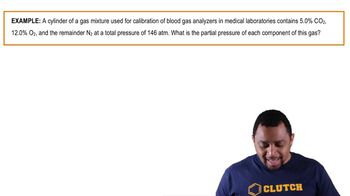
Dalton's Law: Partial Pressure (Simplified) Example 3
2
views
Terms in this set (12)
Hide definitions
Partial Pressure
Pressure contributed by a single gas in a mixture, calculated independently as if it occupied the container alone.
Total Pressure
Sum of all individual gas pressures present in a container of unreacting gases.
Dalton's Law
Principle stating that total pressure equals the sum of all partial pressures in a gas mixture.
Gas Mixture
Combination of two or more unreacting gases sharing the same container.
Ideal Gas Law
Equation relating pressure, volume, temperature, and moles for a gas assuming ideal behavior.
Mole
Unit representing the amount of substance, used to quantify gas particles in calculations.
Gas Constant
Proportionality factor (R) used in the ideal gas law to relate energy, temperature, and amount.
Temperature
Measure of average kinetic energy of gas particles, influencing pressure in a container.
Volume
Space occupied by a gas, affecting its pressure when other variables are held constant.
Percent Composition
Percentage representing how much of a specific gas is present in a mixture.
Fractional Composition
Proportion of a gas in a mixture, found by dividing percent composition by 100%.
Unreacting Gases
Gases that do not chemically interact with each other within a container.
 BackBack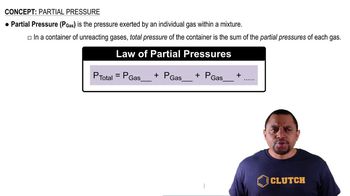
 00:44
00:44