Skip to main content
Introduction to Chemistry
My Course
Learn
Exam Prep
AI Tutor
Study Guides
Flashcards
Explore
Try the app
My Course
Learn
Exam Prep
AI Tutor
Study Guides
Flashcards
Explore
Try the app
Back
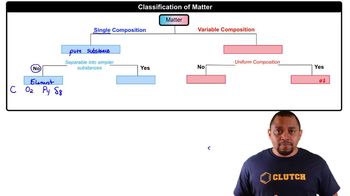
Classification of Matter definitions
You can tap to flip the card.
Matter
You can tap to flip the card.
👆
Matter
Anything that occupies space and has mass, forming the basis for all substances studied in chemistry.
Track progress
Control buttons has been changed to "navigation" mode.
1/14
Related flashcards
Related practice
Recommended videos
Classification of Matter quiz #1
Classification of Matter
40 Terms
Classification of Matter quiz #2
Classification of Matter
40 Terms
Classification of Matter quiz #3
Classification of Matter
10 Terms
Classification of Matter
3. Matter and Energy
5 problems
Topic
States of Matter
3. Matter and Energy
5 problems
Topic
3. Matter and Energy - Part 1 of 2
12 topics
36 problems
Chapter
3. Matter and Energy - Part 2 of 2
1 topic
3 problems
Chapter
Guided course
01:34
Classification of Matter
8328
views
17
rank
Guided course
04:19
Classification of Matter
3709
views
21
rank
Guided course
02:58
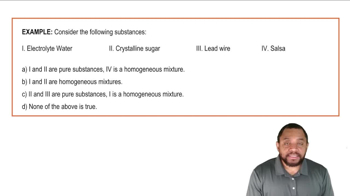
Classification of Matter Example 1
3144
views
3
rank
Terms in this set (14)
Hide definitions
Matter
Anything that occupies space and has mass, forming the basis for all substances studied in chemistry.
Atom
The basic functional unit in chemistry, representing the smallest part of an element retaining its properties.
Element
A substance composed of only one kind of atom, often represented by a symbol on the periodic table.
Compound
A substance formed when two or more different elements are chemically bonded together in fixed proportions.
Mixture
A physical combination of elements and/or compounds where each retains its own properties and can be separated.
Pure Substance
A material with a single, unchanging composition, either an element or a compound.
Homogeneous Mixture
A blend of substances with a uniform appearance and composition throughout, such as air.
Heterogeneous Mixture
A combination of substances where different components are visibly distinct, like oil and water.
Periodic Table
A systematic arrangement of elements, each represented by a symbol, used to identify and classify elements.
Composition
The specific makeup or types of substances present in a sample of matter, determining its classification.
Chemical Bond
A force that holds two or more different elements together within a compound.
Symbol
A one- or two-letter abbreviation used to represent an element, such as C for carbon.
Uniformity
The degree to which a mixture appears the same throughout, distinguishing homogeneous from heterogeneous mixtures.
Separation
The process by which components of a mixture can be physically divided due to the absence of chemical bonds.
 BackBack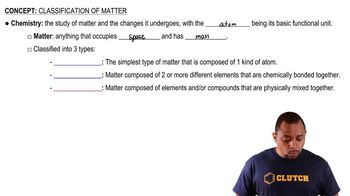
 01:34
01:34