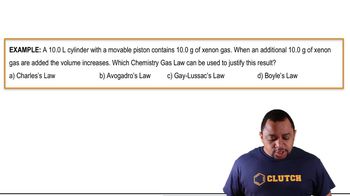
What is the ideal gas law equation that the chemistry gas laws are derived from?
The ideal gas law is PV = nRT, where P is pressure, V is volume, n is moles, R is the gas constant, and T is temperature.
Which two variables does Boyle's Law relate, and how are they related?
Boyle's Law relates pressure and volume, and they are inversely proportional when moles and temperature are constant.
What is the formula for Boyle's Law using initial and final conditions?
The formula is P1V1 = P2V2, where P1 and V1 are initial pressure and volume, and P2 and V2 are final pressure and volume.
How does increasing the pressure on a gas affect its volume according to Boyle's Law?
Increasing the pressure decreases the volume, as they are inversely proportional.
Which two variables does Gay-Lussac's Law relate, and what is their relationship?
Gay-Lussac's Law relates pressure and temperature, and they are directly proportional when moles and volume are constant.
What is the adjusted formula for Gay-Lussac's Law?
The formula is P1/T1 = P2/T2, where P1 and T1 are initial pressure and temperature, and P2 and T2 are final pressure and temperature.
Why must temperature be measured in Kelvin for gas law calculations?
Temperature must be in Kelvin because gas law relationships are based on absolute temperature, and Kelvin ensures all values are positive.
What happens to the pressure of a gas if its temperature increases while volume and moles remain constant?
The pressure increases because the gas particles move faster and collide with the container walls more forcefully.
Which two variables does Avogadro's Law relate, and how are they related?
Avogadro's Law relates volume and moles, and they are directly proportional when pressure and temperature are constant.
What is the formula for Avogadro's Law using initial and final conditions?
The formula is V1/n1 = V2/n2, where V1 and n1 are initial volume and moles, and V2 and n2 are final volume and moles.
If the number of moles of gas in a container increases at constant pressure and temperature, what happens to the volume?
The volume increases because volume and moles are directly proportional.
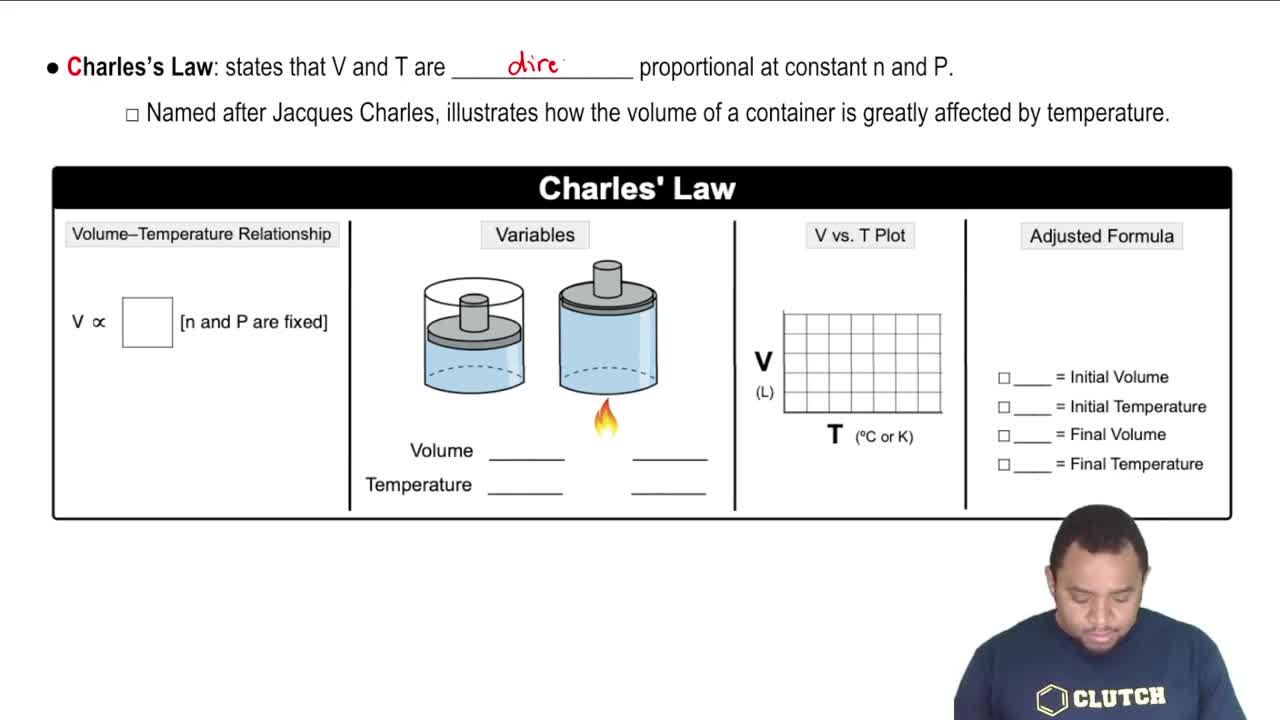
Which two variables does Charles's Law relate, and what is their relationship?
Charles's Law relates volume and temperature, and they are directly proportional when moles and pressure are constant.
What is the adjusted formula for Charles's Law?
The formula is V1/T1 = V2/T2, where V1 and T1 are initial volume and temperature, and V2 and T2 are final volume and temperature.
What happens to the volume of a gas if its temperature increases at constant pressure and moles?
The volume increases because the gas particles gain energy and push the piston outward, expanding the volume.
How are direct and inverse relationships between gas law variables depicted graphically?
Direct relationships are shown as both variables increasing or decreasing together (an upward-sloping line), while inverse relationships show one variable increasing as the other decreases (a downward-sloping curve).
 Back
Back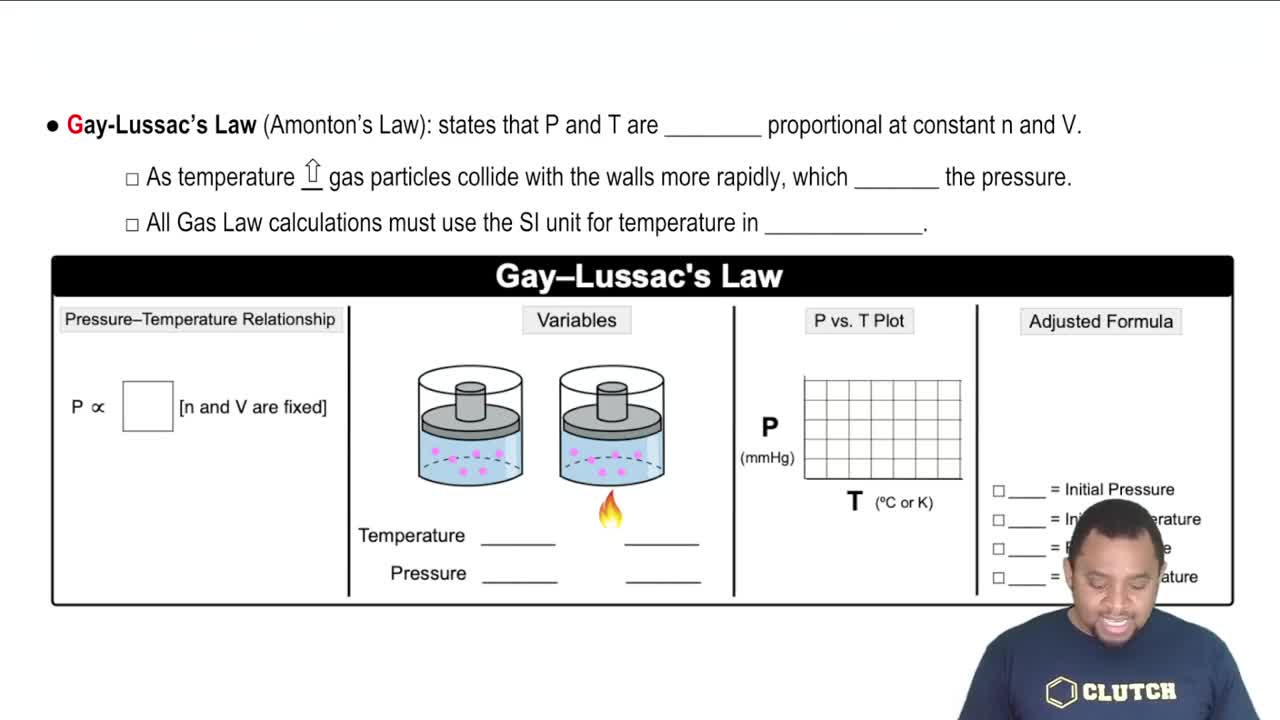
 03:20
03:20