Skip to main content
Introduction to Chemistry
My Course
Learn
Exam Prep
AI Tutor
Study Guides
Flashcards
Explore
Try the app
My Course
Learn
Exam Prep
AI Tutor
Study Guides
Flashcards
Explore
Try the app
Back
Chemical Reaction: Chemical Change definitions
You can tap to flip the card.
Chemical Reaction
You can tap to flip the card.
👆
Chemical Reaction
Process where chemical bonds in substances are broken and new bonds are formed, resulting in new substances with different properties.
Track progress
Control buttons has been changed to "navigation" mode.
1/14
Related flashcards
Related practice
Recommended videos
Chemical Reaction: Chemical Change quiz
Chemical Reaction: Chemical Change
15 Terms
Chemical Reaction: Chemical Change
7. Chemical Reactions
5 problems
Topic
Balancing Chemical Equations (Simplified)
7. Chemical Reactions
5 problems
Topic
7. Chemical Reactions
8 topics
24 problems
Chapter
Guided course
01:24
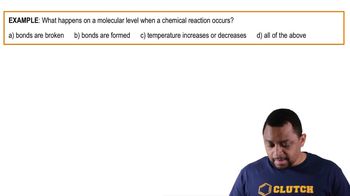
Chemical Reaction: Chemical Change Example 2
12
views
Guided course
00:49
Chemical Reaction: Chemical Change Example 1
7
views
Guided course
02:04
Chemical Reaction: Chemical Change Concept 2
9
views
Terms in this set (14)
Hide definitions
Chemical Reaction
Process where chemical bonds in substances are broken and new bonds are formed, resulting in new substances with different properties.
Chemical Change
Transformation resulting in the formation of one or more new substances, often indicated by observable evidence.
Chemical Bond
Attractive force holding atoms together within molecules or compounds, which can be broken or formed during reactions.
Reactant
Substance present at the start of a reaction that undergoes change to yield new substances.
Product
Substance formed as a result of a chemical reaction, differing in composition from the starting materials.
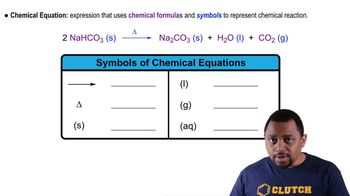
Chemical Equation
Representation using formulas and symbols to show the substances involved and the changes occurring in a reaction.
Reaction Arrow
Symbol in an equation indicating the direction in which reactants are converted to products.
Precipitate
Solid formed from a solution during a chemical reaction, often visible as a new phase.
Aqueous
State where a compound is dissolved in water, resulting in a solution with the compound surrounded by water molecules.
Solid
State of matter characterized by definite shape and volume, often represented by 's' in equations.
Liquid
State of matter with definite volume but no fixed shape, denoted by 'l' in chemical equations.
Gas
State of matter with neither definite shape nor volume, represented by 'g' in chemical equations.
Triangle Symbol
Notation in equations indicating that heat is required or involved in the chemical reaction.
Observable Evidence
Signs such as color change, gas formation, precipitate, or temperature change that indicate a reaction has occurred.
 BackBack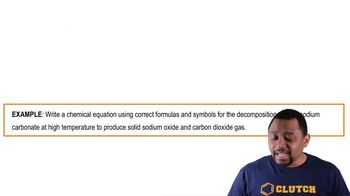
 01:24
01:24