Skip to main content
Introduction to Chemistry
My Course
Learn
Exam Prep
AI Tutor
Study Guides
Flashcards
Explore
Try the app
My Course
Learn
Exam Prep
AI Tutor
Study Guides
Flashcards
Explore
Try the app
Back
Chemical Equilibrium definitions
You can tap to flip the card.
Chemical Equilibrium
You can tap to flip the card.
👆
Chemical Equilibrium
A state where reactant and product concentrations remain constant as forward and reverse reactions occur at equal rates.
Track progress
Control buttons has been changed to "navigation" mode.
1/13
Related flashcards
Related practice
Recommended videos
Chemical Equilibrium quiz
Chemical Equilibrium
15 Terms
Chemical Equilibrium
15. Chemical Equilibrium
5 problems
Topic
The Equilibrium Constant
15. Chemical Equilibrium
5 problems
Topic
15. Chemical Equilibrium
6 topics
16 problems
Chapter
Guided course
03:42
Chemical Equilibrium Concept 1
10
views
Terms in this set (13)
Hide definitions
Chemical Equilibrium
A state where reactant and product concentrations remain constant as forward and reverse reactions occur at equal rates.
Completion
A scenario where all reactants are fully converted into products, leaving no remaining reactant.
Reactant
A substance present at the start of a reaction, which is consumed to form products.
Product
A substance formed as a result of a chemical reaction from reactants.
Reversible Reaction
A process that can proceed in both forward and reverse directions, indicated by double arrows.
Forward Direction
The process in which reactants are converted into products, often represented by k1.
Reverse Direction
The process in which products are converted back into reactants, often represented by k-1.
Double Arrows
A notation used to show that a reaction can proceed in both forward and reverse directions.
Concentration
The amount of a substance present in a given volume, which remains constant at equilibrium.
Plateau
A point on a graph where the amount of reactant or product stops changing and remains steady.
Molecular Level
The scale at which individual particles interact, allowing reactions to continue even when concentrations are constant.
k1
A symbol representing the rate constant for the forward direction of a reversible reaction.
k-1
A symbol representing the rate constant for the reverse direction of a reversible reaction.
 BackBack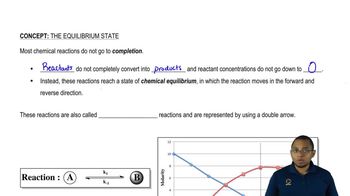
 03:42
03:42