Skip to main content
Introduction to Chemistry
My Course
Learn
Exam Prep
AI Tutor
Study Guides
Flashcards
Explore
Try the app
My Course
Learn
Exam Prep
AI Tutor
Study Guides
Flashcards
Explore
Try the app
Back
Balancing Redox Reactions: Acidic Solutions quiz
You can tap to flip the card.
What is the main difference between balancing simple chemical reactions and redox reactions?
You can tap to flip the card.
👆
What is the main difference between balancing simple chemical reactions and redox reactions?
Balancing redox reactions requires accounting for the transfer of electrons between reactants, not just atoms.
Track progress
Control buttons has been changed to "navigation" mode.
1/15
Related flashcards
Related practice
Recommended videos
Balancing Redox Reactions: Acidic Solutions definitions
Balancing Redox Reactions: Acidic Solutions
15 Terms
Balancing Redox Reactions: Acidic Solutions
16. Oxidation and Reduction
5 problems
Topic
Balancing Redox Reactions: Basic Solutions
16. Oxidation and Reduction
5 problems
Topic
16. Oxidation and Reduction
6 topics
16 problems
Chapter
Guided course
01:46
Balancing Redox Reactions: Acidic Solutions
7
views
Guided course
00:52
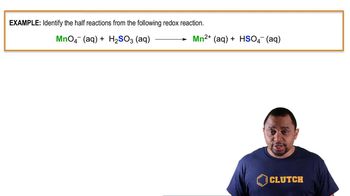
Balancing Redox Reactions: Acidic Solutions Example 1
5
views
Guided course
07:19
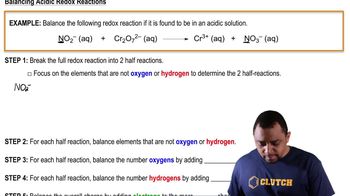
Balancing Redox Reactions: Acidic Solutions Example 2
7
views
Terms in this set (15)
Hide definitions
What is the main difference between balancing simple chemical reactions and redox reactions?
Balancing redox reactions requires accounting for the transfer of electrons between reactants, not just atoms.
In a redox reaction, what happens to the reactant that is oxidized?
The oxidized reactant loses electrons.
What does the reactant that is reduced do in a redox reaction?
The reduced reactant gains electrons.
Under what two types of conditions can redox reactions be balanced?
Redox reactions can be balanced under acidic or basic conditions.
Which ion is typically present in acidic redox reactions?
The H+ ion is typically present in acidic redox reactions.
Besides atoms, what else must be balanced in redox reactions?
Both charge and electrons must be balanced in redox reactions.
What is a half reaction in the context of redox reactions?
A half reaction represents either the oxidation or reduction part of a redox reaction.
How many half reactions are there in a redox reaction?
There are two half reactions: one for oxidation and one for reduction.
When identifying half reactions, which elements should you focus on?
You should focus on elements that are not oxygen or hydrogen.
Why do we focus on elements other than oxygen or hydrogen when identifying half reactions?
Because these elements are usually the ones undergoing oxidation or reduction.
What is the first step in breaking a redox reaction into half reactions?
The first step is to identify the elements being oxidized or reduced, excluding oxygen and hydrogen.
What does balancing a redox reaction under acidic conditions typically involve?
It typically involves adding H+ ions to balance hydrogen atoms.
What is the purpose of balancing charge in redox reactions?
Balancing charge ensures that the total charge is the same on both sides of the equation.
What is the role of electrons in balancing redox reactions?
Electrons are added to one side of the half reaction to balance the loss or gain of electrons.
What should you do after identifying the half reactions in a redox process?
After identifying the half reactions, you balance atoms, charge, and electrons for each half reaction.
 BackBack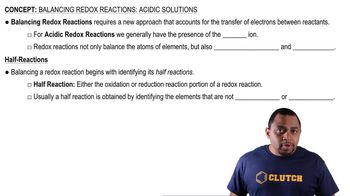
 01:46
01:46