Skip to main content
Introduction to Chemistry
My Course
Learn
Exam Prep
AI Tutor
Study Guides
Flashcards
Explore
Try the app
My Course
Learn
Exam Prep
AI Tutor
Study Guides
Flashcards
Explore
Try the app
Back
Balancing Chemical Equations (Simplified) definitions
You can tap to flip the card.
Chemical Equation
You can tap to flip the card.
👆
Chemical Equation
A symbolic representation showing reactants and products, with atoms and their quantities indicated for both sides.
Track progress
Control buttons has been changed to "navigation" mode.
1/13
Related flashcards
Related practice
Recommended videos
Balancing Chemical Equations (Simplified) quiz
Balancing Chemical Equations (Simplified)
15 Terms
Balancing Chemical Equations (Simplified)
7. Chemical Reactions
5 problems
Topic
Solubility Rules
7. Chemical Reactions
5 problems
Topic
7. Chemical Reactions
8 topics
24 problems
Chapter
Guided course
04:21
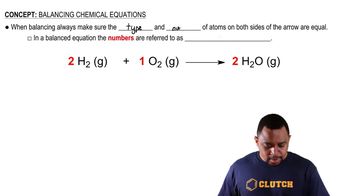
Balancing Chemical Equations (Simplified) Example 1
6
views
Guided course
01:32
Balancing Chemical Equations (Simplified) Concept 1
41
views
3
rank
Terms in this set (13)
Hide definitions
Chemical Equation
A symbolic representation showing reactants and products, with atoms and their quantities indicated for both sides.
Balanced Equation
A symbolic statement where the type and number of atoms are equal on both sides of the arrow.
Coefficient
A number placed before a chemical formula to indicate the quantity of molecules or atoms involved.
Atom
A basic unit of matter, counted and compared on both sides to ensure equations are balanced.
Reactant
A substance present on the left side of the arrow, participating in a chemical change.
Product
A substance formed and shown on the right side of the arrow after a chemical reaction.
Arrow
A symbol separating reactants from products, indicating the direction of the chemical change.
Distribution
The process of applying coefficients to all atoms in a formula to determine total quantities.
Hydrogen
An element often used in examples, requiring careful counting to ensure balanced equations.
Oxygen
A diatomic element commonly appearing in equations, its atoms must be balanced on both sides.
Type of Atom
A specific element present in a reaction, which must be matched on both sides for balance.
Number of Atoms
The total count of each element, calculated using coefficients to check for balance.
Molecule
A group of atoms bonded together, whose quantity is indicated by coefficients in equations.
 BackBack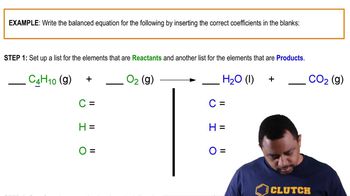
 04:21
04:21