Skip to main content
Intermediate Algebra
My Course
Learn
AI Tutor
Study Guides
Flashcards
Explore
Try the app
My Course
Learn
AI Tutor
Study Guides
Flashcards
Explore
Try the app
Back
The Power of a Quotient Rule definitions
You can tap to flip the card.
Exponent
You can tap to flip the card.
👆
Exponent
A value indicating how many times a base is multiplied by itself, applied to both numerator and denominator in the rule.
Track progress
Control buttons has been changed to "navigation" mode.
1/15
Related flashcards
Recommended videos
The Power of a Quotient Rule quiz
The Power of a Quotient Rule
15 Terms
Guided course
05:14
Power of a Quotient Rule
3
views
Terms in this set (15)
Hide definitions
Exponent
A value indicating how many times a base is multiplied by itself, applied to both numerator and denominator in the rule.
Numerator
The top part of a fraction, receiving the distributed exponent when applying the rule.
Denominator
The bottom part of a fraction, also receiving the distributed exponent in the rule.
Fraction
A mathematical expression representing a quotient, where the rule distributes exponents to both parts.
Quotient
A result of division, often written as a fraction, subject to exponent distribution in the rule.
Power of a Quotient Rule
A principle allowing an exponent outside a fraction to be applied to both numerator and denominator.
Parenthesis
Symbols used to group terms, especially important for negative bases when distributing exponents.
Variable
A symbol representing an unknown value, often raised to an exponent in expressions simplified by the rule.
Negative Base
A value less than zero inside a fraction, requiring careful use of parentheses when raised to a power.
Monomial
An algebraic expression with a single term, which can appear in the numerator or denominator.
Polynomial
An expression with multiple terms, often simplified using the rule when raised to a power.
Numerical Coefficient
A number multiplying a variable, affected by exponent distribution in the rule.
Odd Exponent
A power that is not divisible by two, which preserves the sign of a negative base.
Simplification
The process of reducing expressions to their simplest form after applying the rule.
General Notation
A symbolic representation of the rule, showing how exponents are distributed to both parts of a fraction.
 BackBack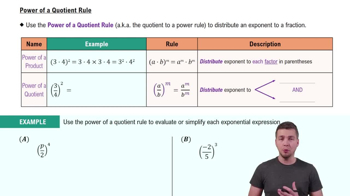
 05:14
05:14