Skip to main content
Intermediate Algebra
My Course
Learn
AI Tutor
Study Guides
Flashcards
Explore
Try the app
My Course
Learn
AI Tutor
Study Guides
Flashcards
Explore
Try the app
Back
Slope of a Line definitions
You can tap to flip the card.
Slope
You can tap to flip the card.
👆
Slope
Measure of steepness, found by dividing change in vertical values by change in horizontal values between two points.
Track progress
Control buttons has been changed to "navigation" mode.
1/15
Related flashcards
Recommended videos
Slope of a Line quiz
Slope of a Line
15 Terms
05:13
Finding the Slope of a Line
2
views
03:04
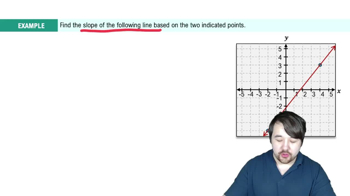
Finding the Slope of a Line Example 1
2
views
Guided course
05:17
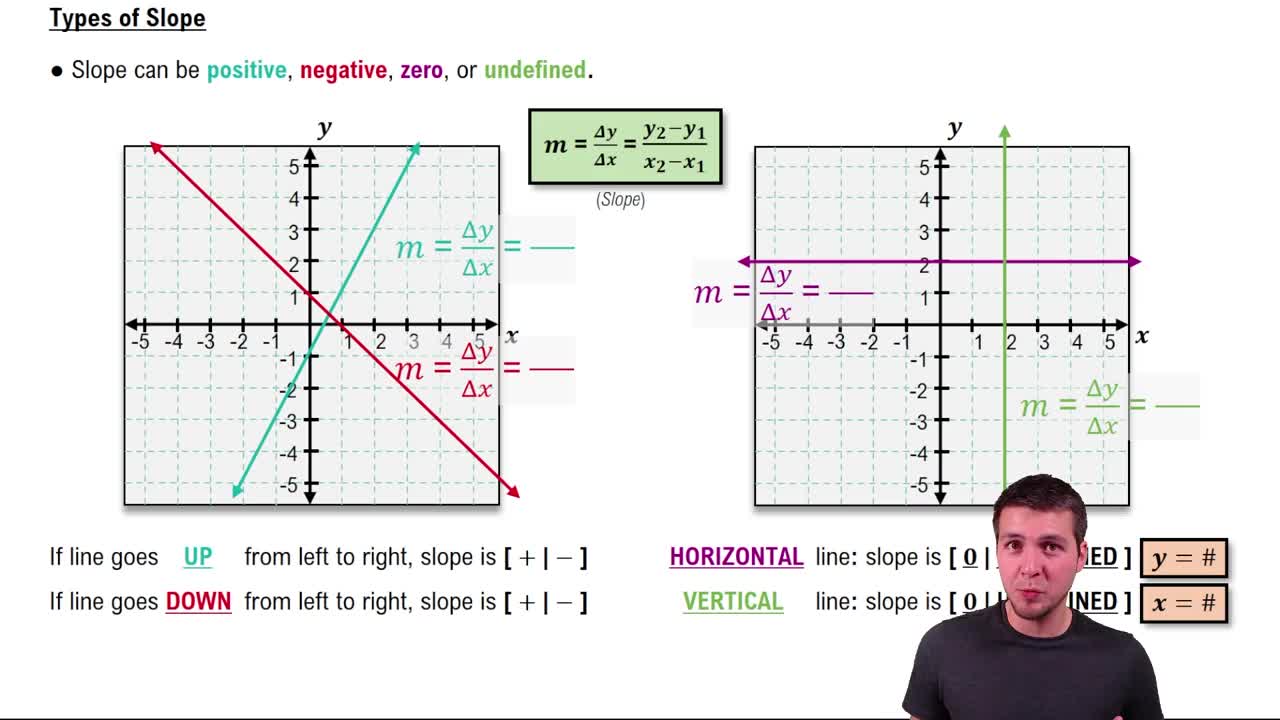
Types of Slope
1
views
Terms in this set (15)
Hide definitions
Slope
Measure of steepness, found by dividing change in vertical values by change in horizontal values between two points.
Rise
Amount of vertical change between two points on a line, used in calculating steepness.
Run
Amount of horizontal change between two points on a line, paired with rise to determine steepness.
Delta Y
Difference in vertical values between two points, representing change along the y-axis.
Delta X
Difference in horizontal values between two points, representing change along the x-axis.
Positive Slope
Steepness where a line rises from left to right, indicating upward movement.
Negative Slope
Steepness where a line falls from left to right, indicating downward movement.
Zero Slope
Flatness of a horizontal line, showing no vertical change regardless of horizontal movement.
Undefined Slope
Steepness of a vertical line, resulting from division by zero in the slope formula.
Ordered Pair
Set of two values representing a point's location on a coordinate plane.
Horizontal Line
Line with constant vertical value, represented by an equation where y equals a fixed number.
Vertical Line
Line with constant horizontal value, represented by an equation where x equals a fixed number.
Linear Equation
Mathematical statement describing a straight line, often involving slope and intercepts.
Steepness
Degree of inclination of a line, determined by the ratio of rise to run.
Graph
Visual representation of points and lines on a coordinate plane, used to illustrate relationships.
 BackBack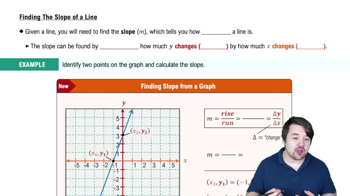
 05:13
05:13