Skip to main content
Intermediate Algebra
My Course
Learn
AI Tutor
Study Guides
Flashcards
Explore
Try the app
My Course
Learn
AI Tutor
Study Guides
Flashcards
Explore
Try the app
Back
Hyperbolas definitions
You can tap to flip the card.
Hyperbola
You can tap to flip the card.
👆
Hyperbola
A conic section with two separate curved branches opening away from each other, defined by a specific standard equation with a minus sign.
Track progress
Control buttons has been changed to "navigation" mode.
1/23
Related flashcards
Recommended videos
Hyperbolas quiz
Hyperbolas
15 Terms
06:51
Intro To Hyperbolas
1
views
03:22
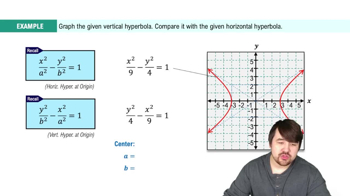
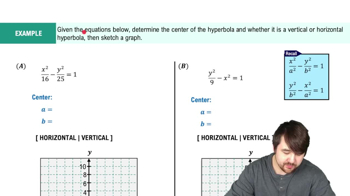
Graphing Hyperbolas Example 3
1
views
07:17
Graphing Hyperbolas Example 1
1
views
Terms in this set (23)
Hide definitions
Hyperbola
A conic section with two separate curved branches opening away from each other, defined by a specific standard equation with a minus sign.
Conic Section
A curve formed by the intersection of a plane and a double-napped cone, including shapes like circles, ellipses, parabolas, and hyperbolas.
Branch
One of the two distinct curved parts of a hyperbola that extend infinitely and open in opposite directions.
Asymptote
A straight line that a hyperbola's branch approaches but never touches, guiding the curve's direction.
Vertex
A point where a branch of a hyperbola crosses the transverse axis, marking the closest approach to the center.
Transverse Axis
The axis passing through the center and both vertices of a hyperbola, determining its orientation.
Center
The midpoint between the vertices and foci of a hyperbola, serving as the reference point for its equation.
Focus
A fixed point used to define a hyperbola, where the constant difference of distances from any point on the curve is measured.
Foci
The two fixed points inside a hyperbola, used to maintain a constant difference in distances from any point on the curve.
Standard Form
An equation format for hyperbolas, featuring squared terms and a minus sign, indicating orientation and center.
Horizontal Hyperbola
A hyperbola with branches opening left and right, identified by the x-term appearing first in its standard equation.
Vertical Hyperbola
A hyperbola with branches opening up and down, identified by the y-term appearing first in its standard equation.
Fundamental Rectangle
A rectangle constructed using a and b values from the equation, whose diagonals determine the asymptotes.
Diagonal
A line segment connecting opposite corners of the fundamental rectangle, used to draw asymptotes.
Orientation
The direction in which a hyperbola opens, determined by which variable appears first in the standard form.
Equation
A mathematical statement representing the relationship between x and y for a hyperbola, typically involving squared terms and a minus sign.
a-value
The distance from the center to each vertex along the transverse axis, found under the leading squared term in the denominator.
b-value
The distance from the center to the rectangle's edge perpendicular to the transverse axis, found under the second squared term.
Minus Sign
A symbol in the standard form equation of a hyperbola, distinguishing it from an ellipse and indicating the curve's nature.
Origin
The point (0,0) on the coordinate plane, often serving as the center for standard hyperbola equations.
Coordinate
A pair of numerical values representing a point's position on the plane, used to locate the center or vertices.
Graph
A visual representation of a hyperbola on the coordinate plane, showing branches, asymptotes, and key features.
Squared Term
An expression where a variable is raised to the second power, as seen in the standard form of a hyperbola.
 BackBack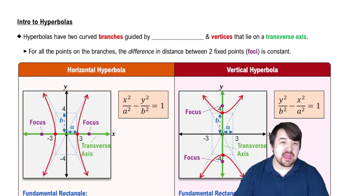
 06:51
06:51