Skip to main content
Intermediate Algebra
My Course
Learn
AI Tutor
Study Guides
Flashcards
Explore
Try the app
My Course
Learn
AI Tutor
Study Guides
Flashcards
Explore
Try the app
Back
Graphing Quadratic Equations quiz
You can tap to flip the card.
What is the general shape of the graph of any quadratic equation?
You can tap to flip the card.
👆
What is the general shape of the graph of any quadratic equation?
The graph of any quadratic equation is a parabola.
Track progress
Control buttons has been changed to "navigation" mode.
1/15
Related flashcards
Recommended videos
Graphing Quadratic Equations definitions
Graphing Quadratic Equations
28 Terms
06:28
Graphing Using the Quadratic Formula
1
views
03:42
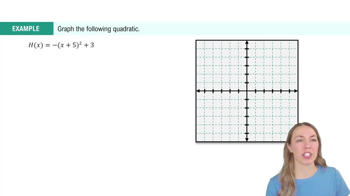
Horizontal and Vertical Shifts of Quadratics Example 2
1
views
04:07
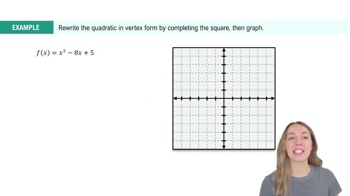
Vertex Form of Quadratics Example 5
Terms in this set (15)
Hide definitions
What is the general shape of the graph of any quadratic equation?
The graph of any quadratic equation is a parabola.
How does the sign of the 'a' coefficient in y = ax^2 + bx + c affect the direction the parabola opens?
If 'a' is positive, the parabola opens upward; if 'a' is negative, it opens downward.
What is the vertex of a parabola in the equation y = a(x-h)^2 + k?
The vertex is at the point (h, k).
How do you determine the axis of symmetry for a parabola in vertex form?
The axis of symmetry is the vertical line x = h.
What effect does the value of 'a' have on the width of the parabola?
If |a| > 1, the parabola is narrower; if 0 < |a| < 1, it is wider.
How does adding or subtracting a value inside the squared term (x-h)^2 affect the graph?
It shifts the graph horizontally: subtracting h shifts right, adding h shifts left.
How does adding or subtracting a value outside the squared term affect the graph?
It shifts the graph vertically: adding k shifts up, subtracting k shifts down.
What is the domain of any quadratic function?
The domain is all real numbers.
How do you find the x-intercepts of a quadratic equation in standard form?
Set y = 0 and solve using the quadratic formula.
What does the discriminant (b^2 - 4ac) tell you about the graph of a quadratic?
It tells how many real x-intercepts the graph has: two if positive, one if zero, none if negative.
How do you find the y-intercept of a quadratic equation?
Plug x = 0 into the equation and solve for y.
What is the formula for the axis of symmetry in standard form y = ax^2 + bx + c?
The axis of symmetry is x = -b/(2a).
How do you find the vertex of a quadratic in standard form?
The x-value is -b/(2a); plug this into the equation to find the y-value.
What happens to the graph of y = ax^2 + bx + c if 'a' is a fraction between -1 and 1?
The parabola becomes wider due to vertical compression.
Why is the form y = a(x-h)^2 + k called 'vertex form'?
Because the vertex is easily identified as (h, k) and the form makes graphing straightforward.
 BackBack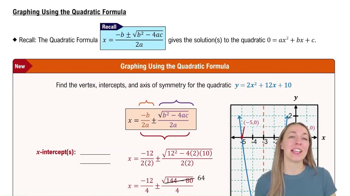
 06:28
06:28