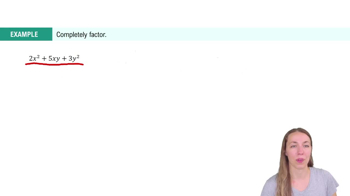
What is the main challenge when factoring trinomials where the leading coefficient is not 1?
The main challenge is that you must account for the leading coefficient when finding binomial factors, making the process more complex than when the leading coefficient is 1.
In the trial and error method, what must the first terms of the binomials multiply to?
They must multiply to the leading term's coefficient times x squared (ax²).
What do the last terms of the binomials need to multiply to in the trial and error method?
They must multiply to the constant term, c, of the trinomial.
How do you check if your binomial factors are correct using the trial and error method?
You use the FOIL technique to expand the binomials and see if you get the original trinomial.
What is the purpose of listing all possible factor pairs for the first and last terms in the trial and error method?
It helps you generate all possible binomial combinations to test for the correct factorization.
When factoring 6x² + 19x - 7, why must you consider the signs of the factors?
Because the sign affects whether the sum of the middle terms matches the middle term of the trinomial.
What step can speed up the trial and error method when checking binomial pairs?
Focus on the sum of the products of the inside and outside terms to see if they add to the middle term.
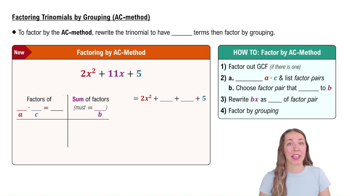
What is the AC method also known as?
It is also called the grouping method.
What is the first step in the AC method?
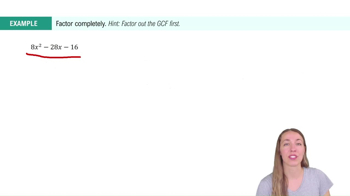
The first step is to factor out the greatest common factor from the trinomial, if there is one.
In the AC method, what do you do after multiplying a and c?
You list all factor pairs of a × c and find the pair that adds to b.
How do you rewrite the middle term in the AC method?
You split the middle term into two terms whose coefficients are the factor pair found in the previous step.
What is the next step after rewriting the trinomial as four terms in the AC method?
You factor by grouping, pairing the terms and factoring out common factors from each pair.
Why is it important that the grouped terms in the AC method have a common binomial factor?
Because you can then factor out this common binomial, completing the factorization.
What should you do if you cannot find two numbers that multiply to a × c and add to b in the AC method?
If no such numbers exist, the trinomial cannot be factored using integers.
How can you check your answer after factoring a trinomial using either method?
Expand the binomial factors using FOIL to verify you get the original trinomial.
 Back
Back
 03:07
03:07