Sometimes clothes cling together when removed from a dryer. What kinds of charges are on the clothes?
Ch.4 Atoms and Elements
Timberlake14th EditionChemistry: An Introduction to General, Organic, and Biological ChemistryISBN: 9781292472249Not the one you use?Change textbook
Chapter 4, Problem 25
On a dry day, your hair flies apart when you brush it. How would you explain this?
Verified step by step guidance1
Understand the concept of static electricity: Static electricity occurs when there is an imbalance of electric charges on the surface of a material. This imbalance can cause objects to attract or repel each other.
Recognize the role of friction: When you brush your hair, friction between the brush and your hair causes electrons to transfer from one surface to another. This transfer creates a charge imbalance.
Identify the charge distribution: As electrons move, your hair strands may become positively charged while the brush becomes negatively charged (or vice versa). Each strand of hair now has the same type of charge.
Explain the repulsion: Like charges repel each other. Since all the hair strands have the same charge, they push away from each other, causing your hair to fly apart.
Relate to environmental conditions: On a dry day, the lack of moisture in the air reduces the ability of charges to dissipate, making static electricity effects more pronounced.

Verified video answer for a similar problem:
This video solution was recommended by our tutors as helpful for the problem above.
Video duration:
2mWas this helpful?
Key Concepts
Here are the essential concepts you must grasp in order to answer the question correctly.
Static Electricity
Static electricity is the buildup of electric charge on the surface of objects. When you brush your hair, friction between the brush and hair can transfer electrons, causing one to become positively charged and the other negatively charged. This imbalance leads to the hair strands repelling each other, making them fly apart.
Recommended video:
Guided course
Galvanic Cell (Simplified) Example 1
Friction
Friction is the resistance that one surface or object encounters when moving over another. In the context of brushing hair, the friction between the brush and hair causes electrons to be transferred, which is essential for generating static electricity. The amount of friction can vary based on the materials involved and environmental conditions.
Recommended video:
Guided course
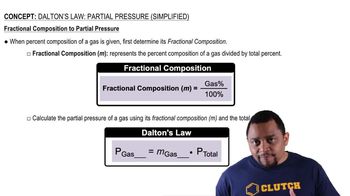
Dalton's Law: Partial Pressure (Simplified) Concept 3
Humidity's Role
Humidity refers to the amount of moisture in the air. On dry days, low humidity means there is less water vapor in the air, which can help dissipate static charges. In contrast, higher humidity allows moisture to conduct electricity, reducing the buildup of static charge and preventing hair from flying apart.
Recommended video:
Guided course
Coenzyme A Example 4
Related Practice
Textbook Question
1
views
Textbook Question
Would you use the atomic number, mass number, or both to determine each of the following?
d. number of electrons in a neutral atom
Textbook Question
Is each of the following statements true or false?
c. Neutrons repel each other.
Textbook Question
Would you use the atomic number, mass number, or both to determine each of the following?
c. number of particles in the nucleus
Textbook Question
Juan added the following elements to the soil to improve potato production. Identify the group and period for and classify each as an alkali metal, an alkaline earth metal, a transition element, or a nonmetal:
b. Cu
Textbook Question
Identify each of the following as describing either a proton, a neutron, or an electron:
a. has the smallest mass