In an old trunk, you find a piece of metal that you think may be aluminum, silver, or lead. You take it to a lab, where you find it has a mass of 217 g and a volume of 19.2 cm3. Using Table 2.10, what is the metal you found?

Ch.2 Chemistry and Measurements
Timberlake14th EditionChemistry: An Introduction to General, Organic, and Biological ChemistryISBN: 9781292472249Not the one you use?Change textbook
Chapter 2, Problem 79a
Solve each of the following problems:
d. A bottle containing 325 g of cleaning solution is used to clean hospital equipment. If the cleaning solution has a specific gravity of 0.850, what volume, in milliliters, of solution was used?
Verified step by step guidance1
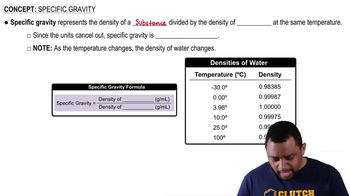
Understand the relationship between specific gravity and density. Specific gravity is the ratio of the density of a substance to the density of water at a given temperature. Since the density of water is approximately 1.00 g/mL, the specific gravity of 0.850 implies the cleaning solution has a density of 0.850 g/mL.
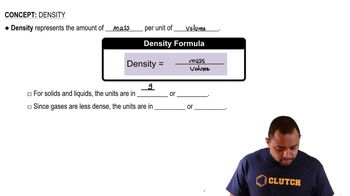
Write the formula for density: \( \text{Density} = \frac{\text{Mass}}{\text{Volume}} \). Rearrange the formula to solve for volume: \( \text{Volume} = \frac{\text{Mass}}{\text{Density}} \).
Substitute the given values into the formula. The mass of the cleaning solution is 325 g, and the density (from the specific gravity) is 0.850 g/mL. The formula becomes \( \text{Volume} = \frac{325}{0.850} \).
Perform the division to calculate the volume in milliliters. Ensure the units are consistent, as the density is in g/mL and the mass is in grams, so the resulting volume will be in milliliters.
Verify the result and ensure it makes sense in the context of the problem. The volume should be a reasonable value for the given mass and specific gravity of the cleaning solution.

Verified video answer for a similar problem:
This video solution was recommended by our tutors as helpful for the problem above.
Video duration:
4mWas this helpful?
Key Concepts
Here are the essential concepts you must grasp in order to answer the question correctly.
Specific Gravity
Specific gravity is a dimensionless quantity that compares the density of a substance to the density of water at a specified temperature. It is calculated as the ratio of the density of the substance to the density of water (1 g/cm³). In this context, a specific gravity of 0.850 indicates that the cleaning solution is less dense than water, which is crucial for determining its volume from mass.
Recommended video:
Guided course
Specific Gravity
Density
Density is defined as mass per unit volume, typically expressed in grams per cubic centimeter (g/cm³) or kilograms per liter (kg/L). It is a fundamental property of materials that influences how substances interact and behave. In this problem, knowing the specific gravity allows us to derive the density of the cleaning solution, which is essential for calculating its volume.
Recommended video:
Guided course
Density
Volume Calculation
Volume is the amount of space occupied by a substance, often measured in milliliters (mL) or liters (L). To find the volume of a substance when its mass and density are known, the formula used is Volume = Mass / Density. In this scenario, the mass of the cleaning solution is given, and by using the derived density from the specific gravity, we can calculate the volume of the solution used.
Recommended video:
Guided course
Calculate Oxidation Numbers
Related Practice
Textbook Question
Textbook Question
Solve each of the following problems:
c. The specific gravity of a vegetable oil is 0.92. What is the mass, in grams, of 750 mL of vegetable oil?
1
views
Textbook Question
State the temperature on the Celsius thermometer to the correct number of significant figures:
<IMAGE>
3
views
Textbook Question
What is the density (g/mL) of each of the following samples?
b. A 14.3 - cm3 sample of tin has a mass of 0.104 kg.
3
views
Textbook Question
Use the density values in TABLE 2.8 to solve each of the following problems:
a. A graduated cylinder contains 18.0 mL of water. What is the new water level, in milliliters, after 35.6 g of silver metal is submerged in the water?
1
views
Textbook Question
Solve each of the following problems:
a. A urine sample has a density of 1.030 g/mL. What is the specific gravity of the sample?