Would you expect to find this segment at the center or at the surface of a protein? Why?

Ch.16 Amino Acids, Proteins, and Enzymes
Timberlake14th EditionChemistry: An Introduction to General, Organic, and Biological ChemistryISBN: 9781292472249Not the one you use?Change textbook
Chapter 16, Problem 60a
What type of interaction would you expect between the following in a tertiary structure?
a. threonine and glutamine
Verified step by step guidance1
Identify the functional groups present in the side chains of threonine and glutamine. Threonine has a hydroxyl (-OH) group, and glutamine has an amide (-CONH2) group.
Recognize that both threonine and glutamine are polar amino acids due to their side chains containing polar functional groups.
Understand that polar side chains can interact through hydrogen bonding. The hydroxyl group of threonine can act as a hydrogen bond donor or acceptor, while the amide group of glutamine can also participate in hydrogen bonding.
Conclude that the interaction between threonine and glutamine in a tertiary structure is likely to be a hydrogen bond, which stabilizes the protein's three-dimensional shape.
Note that these interactions are important for maintaining the overall structure and function of the protein in its folded state.

Verified video answer for a similar problem:
This video solution was recommended by our tutors as helpful for the problem above.
Video duration:
4mWas this helpful?
Key Concepts
Here are the essential concepts you must grasp in order to answer the question correctly.
Amino Acid Properties
Threonine and glutamine are both polar amino acids, which means they have side chains that can form hydrogen bonds with water. This property influences their interactions in a protein's tertiary structure, as polar amino acids tend to be found on the surface of proteins, interacting with the aqueous environment.
Recommended video:
Guided course
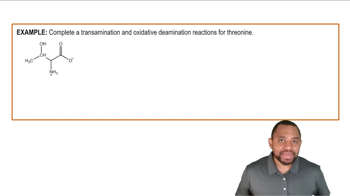
Amino Acid Catabolism: Amino Group Example 2
Hydrogen Bonding
Hydrogen bonding is a key interaction in protein structures, occurring when a hydrogen atom covalently bonded to an electronegative atom (like oxygen or nitrogen) is attracted to another electronegative atom. In the case of threonine and glutamine, their hydroxyl (-OH) and amine (-NH2) groups can form hydrogen bonds, stabilizing the protein's tertiary structure.
Recommended video:
Guided course
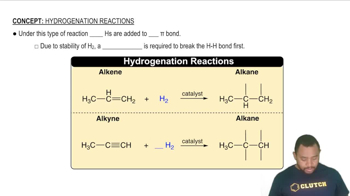
Hydrogenation Reactions Concept 1
Tertiary Structure of Proteins
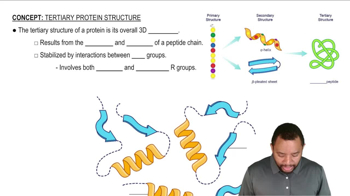
The tertiary structure of a protein refers to its three-dimensional shape formed by the folding of its polypeptide chain. This structure is stabilized by various interactions, including hydrogen bonds, ionic bonds, and hydrophobic interactions, which are crucial for the protein's functionality and interaction with other molecules.
Recommended video:
Guided course
Tertiary Protein Structure Concept 1
Related Practice
Textbook Question
Textbook Question
Seeds and vegetables are often deficient in one or more essential amino acids. Using the following table, state whether each combination provides all of the essential amino acids:
b. lima beans and cornmeal
Textbook Question
Identify the amino acids and type of interaction that occurs between the following R groups in tertiary protein structures:
c. —CH2—SH and HS—CH2—
Textbook Question
Draw the condensed structural formula for Ser–Lys–Asp.
Textbook Question
Identify the amino acids and type of interaction that occurs between the following R groups in tertiary protein structures:
a.
Textbook Question
Fresh pineapple contains the enzyme bromelain that hydrolyzes peptide bonds in proteins.
<IMAGE>
b. Fresh pineapple is used in a marinade to tenderize tough meat. Why?