Ch.13 Carbohydrates
Timberlake - Chemistry: An Introduction to General, Organic, and Biological Chemistry 14th Edition
Timberlake14th EditionChemistry: An Introduction to General, Organic, and Biological ChemistryISBN: 9781292472249Not the one you use?Change textbook
Chapter 13, Problem 45b

Identify the disaccharide that fits each of the following descriptions: 
a. ordinary table sugar

Verified step by step guidance
1
Understand the problem: The question asks us to identify the disaccharide commonly referred to as 'ordinary table sugar.' Disaccharides are carbohydrates composed of two monosaccharide units linked by a glycosidic bond.
Recall the common disaccharides: The most well-known disaccharides are sucrose, lactose, and maltose. Each has a specific composition and function.
Focus on sucrose: Sucrose is the disaccharide commonly known as table sugar. It is composed of one glucose molecule and one fructose molecule linked by an α(1→2) glycosidic bond.
Relate to everyday use: Sucrose is widely used as a sweetener in households and food products, making it the most likely candidate for 'ordinary table sugar.'
Confirm the answer: Based on its composition and common usage, the disaccharide that fits the description of 'ordinary table sugar' is sucrose.

Verified video answer for a similar problem:

This video solution was recommended by our tutors as helpful for the problem above.
Video duration:
57s

Key Concepts

Here are the essential concepts you must grasp in order to answer the question correctly.

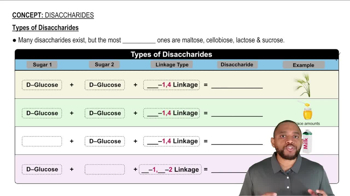
Disaccharides

Disaccharides are carbohydrates formed by the combination of two monosaccharides through a glycosidic bond. They serve as important energy sources in biological systems. Common examples include sucrose, lactose, and maltose, each composed of different monosaccharide units.
Recommended video:
Guided course
3:39
Types of Disaccharides Concept 1

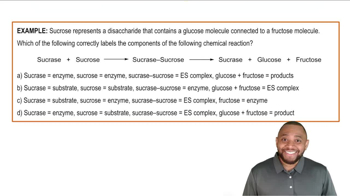
Sucrose

Sucrose is a specific type of disaccharide commonly known as table sugar. It is composed of one glucose molecule and one fructose molecule. Sucrose is widely used as a sweetener in food and beverages and is naturally found in many plants, particularly in sugarcane and sugar beets.
Recommended video:
Guided course
1:36
Enzyme-Substrate Complex Example 1

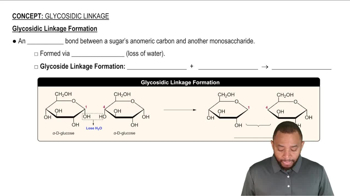
Glycosidic Bond

A glycosidic bond is a type of covalent bond that links monosaccharides together to form disaccharides and polysaccharides. This bond is formed through a dehydration reaction, where a water molecule is released. The nature of the glycosidic bond can affect the properties and digestibility of the resulting carbohydrate.
Recommended video:
Guided course
1:44
Glycosidic Linkage Formation Concept 1