Ch.10 Acids and Bases and Equilibrium
Timberlake - Chemistry: An Introduction to General, Organic, and Biological Chemistry 14th Edition
Timberlake14th EditionChemistry: An Introduction to General, Organic, and Biological ChemistryISBN: 9781292472249Not the one you use?Change textbook
Chapter 10, Problem 35

Why does a neutral solution have a pH of 7.0?

Verified step by step guidance
1
Understand the concept of pH: pH is a measure of the hydrogen ion concentration ([H⁺]) in a solution. It is calculated using the formula: pH=-log10([H⁺]).
Recognize the definition of a neutral solution: A neutral solution is one where the concentrations of hydrogen ions ([H⁺]) and hydroxide ions ([OH⁻]) are equal. This occurs in pure water at 25°C.
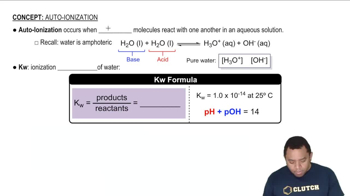
Recall the ion-product constant for water (Kw): At 25°C, water undergoes self-ionization, producing equal amounts of H⁺ and OH⁻ ions. The ion-product constant is given by: Kw=[H⁺]×[OH⁻]=1.0×10⁻¹⁴.
Determine the [H⁺] in a neutral solution: Since [H⁺] = [OH⁻] in a neutral solution, we can solve for [H⁺] by taking the square root of Kw: [H⁺]=1.0×10⁻¹⁴.
Calculate the pH of a neutral solution: Substitute the value of [H⁺] into the pH formula. For a neutral solution at 25°C, this results in a pH of 7.0, which is the midpoint of the pH scale (ranging from 0 to 14).

Verified video answer for a similar problem:

This video solution was recommended by our tutors as helpful for the problem above.
Video duration:
3m

Key Concepts

Here are the essential concepts you must grasp in order to answer the question correctly.

pH Scale

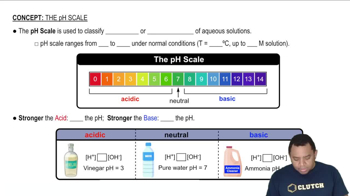
The pH scale measures the acidity or basicity of a solution, ranging from 0 to 14. A pH of 7 is considered neutral, indicating that the concentration of hydrogen ions (H+) is equal to that of hydroxide ions (OH-). Values below 7 represent acidic solutions, while values above 7 indicate basic solutions.
Recommended video:

Water Ionization

Water (H2O) can dissociate into hydrogen ions (H+) and hydroxide ions (OH-) in a process called ionization. In pure water at 25°C, this dissociation occurs to a very small extent, resulting in equal concentrations of H+ and OH-, which is approximately 1 x 10^-7 moles per liter, leading to a neutral pH of 7.
Recommended video:
Guided course
02:22
Auto-Ionization and Kw

Equilibrium in Pure Water

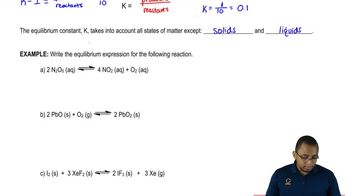
In a neutral solution, the equilibrium between H+ and OH- ions is maintained, meaning that any addition of acids or bases will disrupt this balance. At a pH of 7, the concentrations of H+ and OH- are equal, demonstrating that pure water is neither acidic nor basic, thus maintaining its neutral status.
Recommended video:
Guided course
03:43
The Equilibrium Constant Example 1