Ch.10 Acids and Bases and Equilibrium
Timberlake - Chemistry: An Introduction to General, Organic, and Biological Chemistry 14th Edition
Timberlake14th EditionChemistry: An Introduction to General, Organic, and Biological ChemistryISBN: 9781292472249Not the one you use?Change textbook
Chapter 10, Problem 64

When food enters the stomach, HCl is released and the [H3O+] of the stomach fluid rises to 4 × 10⁻² M. What is the pH of the stomach fluid?

Verified step by step guidance
1
Understand the relationship between [H₃O⁺] and pH. The pH of a solution is calculated using the formula: pH=-log([H3O]). This formula tells us that pH is the negative logarithm (base 10) of the hydronium ion concentration.
Identify the given value for [H₃O⁺]. From the problem, the hydronium ion concentration is 4×10⁻² M.
Substitute the given [H₃O⁺] value into the pH formula. This gives: pH=-log(4×10⁻²).
Break the calculation into two parts for clarity. First, use the logarithmic property: log(4×10⁻²)=log(4)+log(10-2). Then, recall that log(10-2)=-2.
Combine the results. The pH is calculated as: pH=-(log(4)+-2). Simplify further to find the final pH value.

Verified video answer for a similar problem:

This video solution was recommended by our tutors as helpful for the problem above.
Video duration:
1m

Key Concepts

Here are the essential concepts you must grasp in order to answer the question correctly.

pH Scale

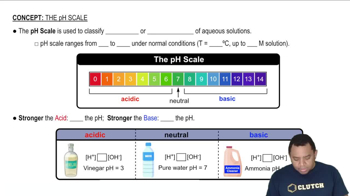
The pH scale measures the acidity or basicity of a solution, ranging from 0 to 14. A pH of 7 is neutral, while values below 7 indicate acidity and above 7 indicate alkalinity. The scale is logarithmic, meaning each whole number change represents a tenfold change in hydrogen ion concentration.
Recommended video:

Hydronium Ion Concentration

Hydronium ion concentration, represented as [H₃O⁺], indicates the amount of hydronium ions present in a solution. It is directly related to the acidity of the solution; higher concentrations correspond to lower pH values. In this case, a concentration of 4 x 10⁻² M indicates a significant level of acidity.
Recommended video:
Guided course
00:52
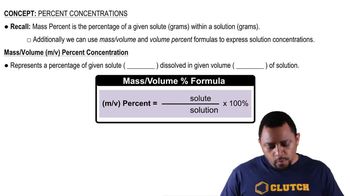
Percent Concentrations Concept 1

Calculating pH

To calculate pH, the formula pH = -log[H₃O⁺] is used, where [H₃O⁺] is the concentration of hydronium ions in moles per liter. This calculation allows us to determine the acidity of the solution quantitatively. For example, if [H₃O⁺] is 4 x 10⁻² M, the pH can be calculated to find the exact acidity level.
Recommended video:
Guided course
01:46
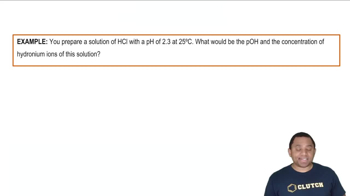
pH and pOH Example