Ch.10 Acids and Bases and Equilibrium
Timberlake - Chemistry: An Introduction to General, Organic, and Biological Chemistry 14th Edition
Timberlake14th EditionChemistry: An Introduction to General, Organic, and Biological ChemistryISBN: 9781292472249Not the one you use?Change textbook
Chapter 10, Problem 72a

Identify each of the following as an acid or a base:
b. H2SO3

Verified step by step guidance
1
Step 1: Recall the definition of acids and bases. Acids are substances that donate protons (H⁺ ions) in aqueous solutions, while bases are substances that accept protons or produce hydroxide ions (OH⁻) in aqueous solutions.
Step 2: Examine the chemical formula of the given compound, H₂SO₃. This is sulfurous acid, which contains hydrogen atoms that can potentially be donated as H⁺ ions.
Step 3: Recognize that the presence of hydrogen atoms at the beginning of the formula (H₂) is a common indicator of an acid. These hydrogens are ionizable and can dissociate in water to release H⁺ ions.
Step 4: Consider the context of the compound in water. When H₂SO₃ dissolves in water, it dissociates partially to form H⁺ ions and HSO₃⁻ ions, confirming its behavior as an acid.
Step 5: Conclude that H₂SO₃ is an acid because it donates H⁺ ions in aqueous solutions, which aligns with the definition of an acid.

Verified video answer for a similar problem:

This video solution was recommended by our tutors as helpful for the problem above.
Video duration:
1m

Key Concepts

Here are the essential concepts you must grasp in order to answer the question correctly.

Acids and Bases

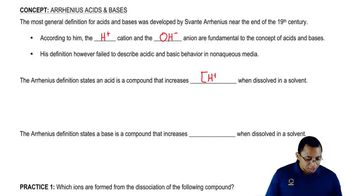
Acids are substances that can donate protons (H⁺ ions) in a solution, while bases are substances that can accept protons. This definition is rooted in the Brønsted-Lowry theory, which emphasizes the transfer of protons in acid-base reactions. Understanding this distinction is crucial for classifying compounds like H₂SO₃.
Recommended video:
Guided course
03:11
Arrhenius Acids & Bases Concept 1

Sulfurous Acid (H₂SO₃)

H₂SO₃, or sulfurous acid, is a weak acid formed when sulfur dioxide (SO₂) dissolves in water. It can dissociate in solution to release H⁺ ions, which is characteristic of acids. Recognizing H₂SO₃ as an acid is essential for understanding its behavior in chemical reactions and its role in various environmental processes.
Recommended video:

pH Scale

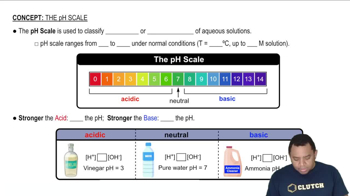
The pH scale measures the acidity or basicity of a solution, ranging from 0 (strongly acidic) to 14 (strongly basic), with 7 being neutral. A solution with a pH less than 7 indicates the presence of more H⁺ ions, typical of acids like H₂SO₃. Familiarity with the pH scale helps in predicting the properties and reactions of acids and bases.
Recommended video: