
Textbook Question
Determine whether each of the following chemical equations is balanced or not balanced:
d.
 Verified step by step guidance
 01:32
01:32 01:32
01:32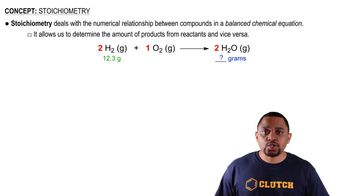 01:16
01:16Determine whether each of the following chemical equations is balanced or not balanced:
d.
The chemical reaction of hydrogen with oxygen produces water.
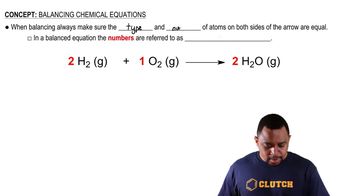
2 H2(g) + O2(g) → 2 H2O(g)
c. How many moles of H2O form when 2.5 moles of O2 reacts?
Identify each of the following as an oxidation or a reduction:
c. Cr3+(aq) + 3e– → Cr(s)
Balance each of the following chemical equations:
c. Sb2S3(s) + HCl(aq) → SbCl3(aq) + H2S(g)
In the mitochondria of human cells, energy is provided by the oxidation and reduction reactions of the iron ions in the cytochromes in electron transport. Identify each of the following as an oxidation or a reduction:
a. Fe3+ + e– → Fe2+
Calculate the mass, in grams, for each of the following:
e. 2.08 moles of (NH4)2SO4