Stearic acid and linoleic acid each have 18 carbon atoms. Why does stearic acid melt at 69 °C but linoleic acid melts at –5 °C?
Ch.15 Lipids
Timberlake13th EditionChemistry: An Introduction to General, Organic, and Biological ChemistryISBN: 9780134421353Not the one you use?Change textbook
Chapter 15, Problem 7a
Draw the line-angle formula for each of the following fatty acids:
a. palmitic acid
Verified step by step guidance1
Understand the structure of palmitic acid: Palmitic acid is a saturated fatty acid with the molecular formula C16H32O2. It consists of a 16-carbon chain with no double bonds and a carboxylic acid (-COOH) functional group at one end.
Identify the components of the line-angle formula: In a line-angle formula, each vertex represents a carbon atom, and lines represent bonds between them. Hydrogen atoms bonded to carbon are implied and not explicitly shown unless part of a functional group.
Start drawing the chain: Begin with the carboxylic acid group (-COOH) at one end. Represent the carbon of the carboxylic acid as a vertex, and draw a double bond to oxygen and a single bond to a hydroxyl group (-OH).
Extend the carbon chain: Draw a straight chain of 15 additional carbon atoms connected by single bonds. Each vertex represents a carbon atom, and the chain should be linear since palmitic acid is saturated.
Verify the structure: Ensure the chain has 16 carbons in total, with the carboxylic acid group at one end. Double-check that there are no double bonds in the chain, as palmitic acid is fully saturated.

Verified video answer for a similar problem:
This video solution was recommended by our tutors as helpful for the problem above.
Video duration:
2mWas this helpful?
Key Concepts
Here are the essential concepts you must grasp in order to answer the question correctly.
Line-Angle Formula
The line-angle formula, also known as the skeletal formula, is a simplified way of representing organic molecules. In this representation, carbon atoms are implied at the ends of lines and at intersections, while hydrogen atoms are usually omitted for clarity. This method allows chemists to visualize the structure of molecules quickly and efficiently, focusing on the connectivity of atoms rather than individual bonds.
Recommended video:
Guided course
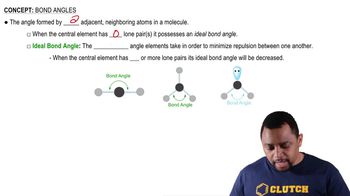
Bond Angles (Simplified) Concept 1
Fatty Acids
Fatty acids are carboxylic acids with long hydrocarbon chains, which can be saturated or unsaturated. Saturated fatty acids, like palmitic acid, contain no double bonds between carbon atoms, resulting in a straight chain structure. Understanding the structure of fatty acids is crucial for studying their properties and biological functions, as they play significant roles in energy storage and cell membrane composition.
Recommended video:
Guided course
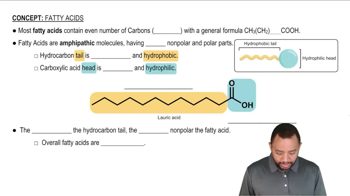
Fatty Acids Concept 1
Palmitic Acid
Palmitic acid is a saturated fatty acid with the chemical formula C16H32O2, consisting of a 16-carbon chain and a carboxylic acid group. It is one of the most common fatty acids found in animals and plants, often serving as a building block for lipids. Recognizing its structure is essential for understanding its role in metabolism and its impact on health, particularly in relation to dietary fats.
Recommended video:
Guided course
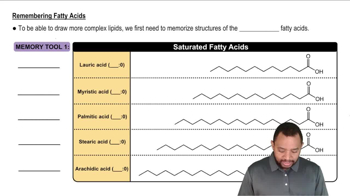
Fatty Acids Concept 5
Related Practice
Textbook Question
Textbook Question
For each of the following fatty acids, give the shorthand notation for the number of carbon atoms and double bonds, and classify as saturated, monounsaturated, or polyunsaturated:
a. linoleic acid
Textbook Question
For each of the following fatty acids, give the shorthand notation for the number of carbon atoms and double bonds, and classify as saturated, monounsaturated, or polyunsaturated:
a. lauric acid
Textbook Question
How does the structure of a fatty acid with a cis double bond differ from the structure of a fatty acid with a trans double bond?
Textbook Question
Describe some similarities and differences in the structures of a saturated fatty acid and an unsaturated fatty acid.
Textbook Question
What are some functions of lipids in the body?