Ch.10 Acids and Bases and Equilibrium
Timberlake - Chemistry: An Introduction to General, Organic, and Biological Chemistry 13th Edition
Timberlake13th EditionChemistry: An Introduction to General, Organic, and Biological ChemistryISBN: 9780134421353Not the one you use?Change textbook
Chapter 10, Problem 41

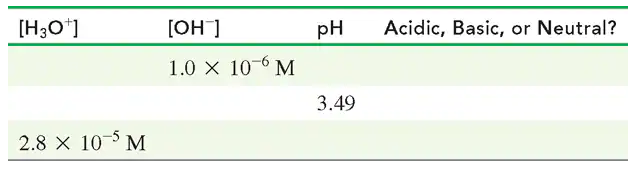
Complete the following table:

Verified step by step guidance
1
Step 1: Recall the relationship between pH and the concentration of hydronium ions ([H₃O⁺]). The formula is: pH=-log([H₃O⁺]). Rearrange this formula to solve for [H₃O⁺]: [H₃O⁺]=10-pH.
Step 2: Substitute the given pH value (2.50) into the formula to calculate [H₃O⁺]. This will give the concentration of hydronium ions in moles per liter.
Step 3: Use the relationship between [H₃O⁺] and [OH⁻] in water, which is governed by the ion product constant for water: Kw=[H₃O⁺]×[OH⁻]. At 25°C, Kw=10-14. Rearrange this formula to solve for [OH⁻]: [OH⁻]=10-14/[H₃O⁺].
Step 4: Determine whether the substance is acidic, neutral, or basic based on the pH value. A pH less than 7 indicates an acidic solution, a pH of 7 indicates a neutral solution, and a pH greater than 7 indicates a basic solution. Since the pH is 2.50, the solution is acidic.
Step 5: Complete the table by filling in the calculated values for [H₃O⁺] and [OH⁻], and indicate that the solution is acidic based on the pH value.

Verified video answer for a similar problem:

This video solution was recommended by our tutors as helpful for the problem above.
Video duration:
1m

Key Concepts

Here are the essential concepts you must grasp in order to answer the question correctly.

pH Scale

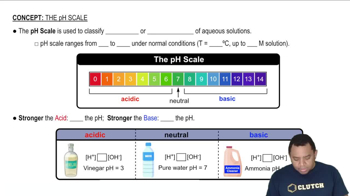
The pH scale measures the acidity or basicity of a solution, ranging from 0 to 14. A pH of 7 is considered neutral, while values below 7 indicate acidity and values above 7 indicate basicity. The scale is logarithmic, meaning each whole number change represents a tenfold change in acidity or basicity.
Recommended video:

Hydronium and Hydroxide Ions

In aqueous solutions, the concentration of hydronium ions (H3O+) and hydroxide ions (OH-) determines the pH. An increase in H3O+ concentration results in a lower pH (more acidic), while an increase in OH- concentration results in a higher pH (more basic). The product of these concentrations is constant at 25°C, known as the ion product of water.
Recommended video:
Guided course
02:31
Polyatomic Ions

Acidic, Neutral, or Basic Solutions

Solutions can be classified as acidic, neutral, or basic based on their pH values. Acidic solutions have a pH less than 7, neutral solutions have a pH of exactly 7, and basic solutions have a pH greater than 7. The classification helps in understanding the chemical behavior and reactivity of substances in different environments.
Recommended video:
Guided course
01:04
Balancing Redox Reactions: Basic Solutions